For trusts and estates lawyers at small US firms
AI for Estate Planning Attorneys and AI Estate Planning Software for Trust Review
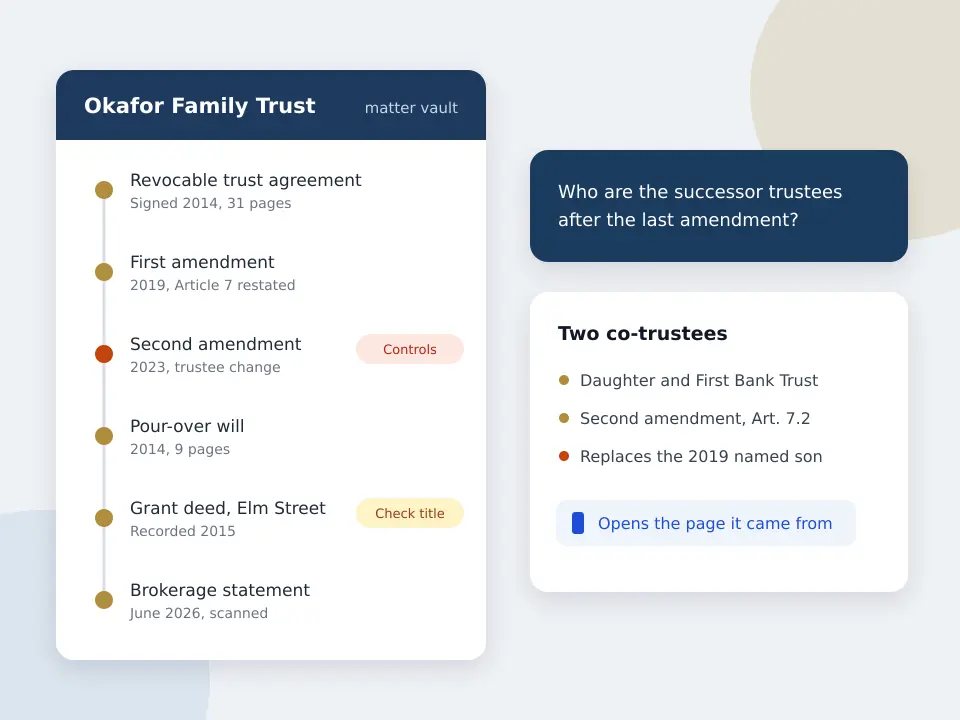
Upload a client's existing plan, the trust, every amendment, the pour-over will, deeds and account statements, and ask it what controls. Who the successor trustees are now, which assets were never retitled, what changed in 2019. Every answer names the document and page it came from.
Competitor prices are taken from each vendor's own pricing page or labeled as third-party reports. CaseClerk prices are the ones on our pricing page.
Review a client's estate plan now
Drop in the trust, amendments, will, deeds and statements for one client and ask across all of them. Every answer cites its source. 25 pages free, no card.
Free preview, no account needed: up to 3 files and 10 pages.
What AI do estate planning attorneys actually need?
Estate planning attorneys use AI for two different jobs: drafting new documents and reading existing ones. Drafting tools such as WealthCounsel, Gavel and Relaw assemble wills and trusts from templates and intake answers. Reading tools take a stack of documents someone else wrote, a 2014 trust with three amendments, a will, deeds and statements, and tell you what they say, with the page cited.
CaseClerk is a reading tool. It does not draft a will or a trust. It is built for the hours you spend on intake of an existing plan, trust administration, funding reviews and trust or will contests, at a published price of $99 to $499 a month.
- 1,000
- Files per client matter in one CaseClerk vault
- 18
- File formats read, including scanned PDFs of signed originals
- $99
- CaseClerk Solo per month, published, 2,500 pages
- 25
- Pages in the free trial, no card
What AI estate planning software has to do with a real client file
- Read the trust with every amendment
- Restatements and amendments change single articles years apart. Ask which version of Article 7 controls today and get the amendment and section that says so, not a guess from the original instrument.
- Check funding against the deeds
- Upload the deeds, brokerage statements and beneficiary forms next to the trust schedule. Ask which listed assets are actually titled in the trust and which are still in the client's own name.
- Find fiduciaries and powers fast
- Successor trustees, guardians, agents under the power of attorney, distribution standards, spendthrift and no-contest clauses. One question returns each one with the page.
- Read scans of signed originals
- Older plans arrive as photocopies with handwritten initials. CaseClerk reads scanned PDFs, Word files and spreadsheets, 18 formats in all, in the same vault.
- Every answer cites its source
- Each answer names the document and page it relied on, so you verify the clause yourself before it goes into a letter to the client or the trustee.
- One vault per client
- Each client or estate is its own matter, kept apart from every other file. We do not use your documents to train any AI model of our own.
How estate plan review works in CaseClerk
-
1
Create a matter for the client or estate
One vault per family or per estate keeps their documents apart from everyone else's.
-
2
Upload the plan and the paper trail
The trust, amendments and restatements, wills and codicils, powers of attorney, deeds, account statements and beneficiary designations. Up to 1,000 files.
-
3
Ask what a reviewing attorney would ask
Who serves as trustee now? What are the distribution terms for the grandchildren? Which real property is outside the trust?
-
4
Verify the cited page and advise
Open the page behind each answer, confirm it, and write the client memo or the trustee letter with the citation already in hand.
AI estate planning software compared by what it does and what it costs
Most AI estate planning tools are drafting platforms. That is a different job from reading a plan you did not write. Prices below come from each vendor's own page unless marked as reported.
| Tool | Main job | Where it falls short for reviewing an existing plan | US price |
|---|---|---|---|
| WealthCounsel (Wealth Docx) | Drafting wills and trusts from a large clause library, the long-time standard for established practices | Built to produce your firm's documents, not to read another firm's 2014 trust | Not printed on its site, reported around $200 to $400 per attorney a month |
| Gavel | Turns your own templates into client intake forms that generate documents | You build the templates first, and it reads nothing it did not create | From $83 a month (gavel.io pricing page) |
| Relaw | AI estate planning drafting with digital questionnaires, a Word add-in and a meeting notetaker | Aimed at producing new plans and running intake, not at auditing a stack of old ones | Standard $299 a month or $269 billed yearly, Pro $399 or $349 (relaw.ai pricing page) |
| General AI chat (ChatGPT, Claude) | Explaining a clause you paste in | Loses track across a trust plus three amendments and twenty statements, and confidentiality depends on the plan tier | About $20 to $30 per user a month for business tiers |
| CaseClerk | Reads the whole client file and answers with the page cited | No drafting, no document assembly, no client portal. Pair it with your drafting software | $99, $249 or $499 a month, published |
Competitor prices change. Check each vendor before you buy.
Who uses CaseClerk in a trusts and estates practice
New clients who bring an old plan
A couple arrives with a 2012 joint trust, a 2018 restatement and two amendments from a lawyer who retired. You need to know what it does before you quote the update, and you cannot bill four hours to find out.
Trust administration after a death
The successor trustee hands you a box of statements, deeds and the trust. You need the distribution provisions, the trustee powers and the asset picture in one place before the first meeting.
Funding reviews
Compare the trust schedule against recorded deeds and the latest account statements to find the house, the brokerage account or the LLC interest that never made it into the trust.
Will and trust contests
Read every prior version of the plan, the drafting attorney's file and the medical records in one matter when capacity or undue influence is in dispute, with each finding sourced for the brief.
Best AI for estate planning attorneys, by the job you need done
The best AI for an estate planning attorney depends on whether the bottleneck is producing documents or reading them. If most of your hours go to drafting new plans, a drafting platform like WealthCounsel, Gavel or Relaw is the right first purchase. If the hours go to understanding plans you did not write, administering trusts or litigating them, a document reading tool like CaseClerk pays back faster.
Plenty of practices need both. They are complementary: the drafting software produces your firm's plan, and CaseClerk reads the client's old plan, the deeds and the statements so you know what you are replacing or administering.
| If your week looks like this | Buy first |
|---|---|
| Mostly new plans for new clients | A drafting platform (WealthCounsel, Gavel, Relaw) |
| Many existing plans to update or restate | CaseClerk for intake review, then your drafting tool |
| Trust administration and probate | CaseClerk |
| Trust and will contests | CaseClerk, plus your litigation tools |
Can AI write a trust?
AI drafting tools can produce a first draft of a revocable trust, but an attorney still has to review, adapt and supervise it. Template platforms assemble trusts from vetted clause libraries, which is safer than a chat assistant writing from scratch. CaseClerk does not draft trusts. It reads the ones that already exist, which is where much of an estate practice's unbilled time actually goes.
Will AI replace estate planning attorneys?
No. AI replaces the hours spent locating provisions, not the advice. Deciding whether a client needs a restatement or an amendment, how to handle a blended family, or what a trustee may do under an ambiguous distribution standard is legal judgment under state law. AI shortens the reading that comes before that judgment, so a small firm can take more matters without adding staff.
Is it safe to upload a client's estate plan to AI?
It can be, if the tool keeps the client's documents private and you supervise the output. ABA Formal Opinion 512 expects lawyers to understand how a tool handles confidential information before using it. Estate files carry account numbers, Social Security numbers and family details, so avoid consumer chat apps that may keep or train on what you paste. In CaseClerk each client is a separate matter vault and we do not use your documents to train any AI model of our own.
What does AI estate planning software cost a small firm?
Expect roughly $83 to $400 a month per attorney for drafting platforms and $99 to $499 a month for CaseClerk. Gavel starts at $83 a month and Relaw at $269 a month billed yearly, both on their own pricing pages. WealthCounsel does not print a price; third-party reviews report about $200 to $400 per attorney a month. CaseClerk Solo is $99 a month for 2,500 pages, Professional $249 for 10,000 pages and Firm $499 for 30,000 pages, with annual billing at six months' price.
AI for estate planning attorneys, questions from practitioners
What is the best AI for estate planning attorneys?
Can AI create a trust for me?
Can AI read a trust with multiple amendments?
Does CaseClerk work with my drafting software?
How much does CaseClerk cost for an estate planning practice?
Is AI estate planning software secure enough for client financial records?
Review the next client's plan in one sitting
Upload the trust, amendments, will, deeds and statements, ask what controls, and check the page behind every answer. Plans from $99 a month, trial on 25 pages with no card.
Start free trialKeep reading
AI contract review software
Read a whole set of agreements and amendments at once, with every answer sourced.
Claude for lawyers
Which Claude plan a firm needs, what it costs per lawyer and what Heppner means for privilege.
ChatGPT for lawyers
ChatGPT plans for law firms, cost per lawyer and the confidentiality settings that matter.
CaseClerk pricing
Solo $99, Professional $249, Firm $499 a month, annual billing at six months' price.
Choose your plan
Put one matter in a vault and ask it the question you would ask a colleague
Sign up