For deal lawyers at small and mid-size firms
AI Due Diligence Software for M&A and Legal Due Diligence
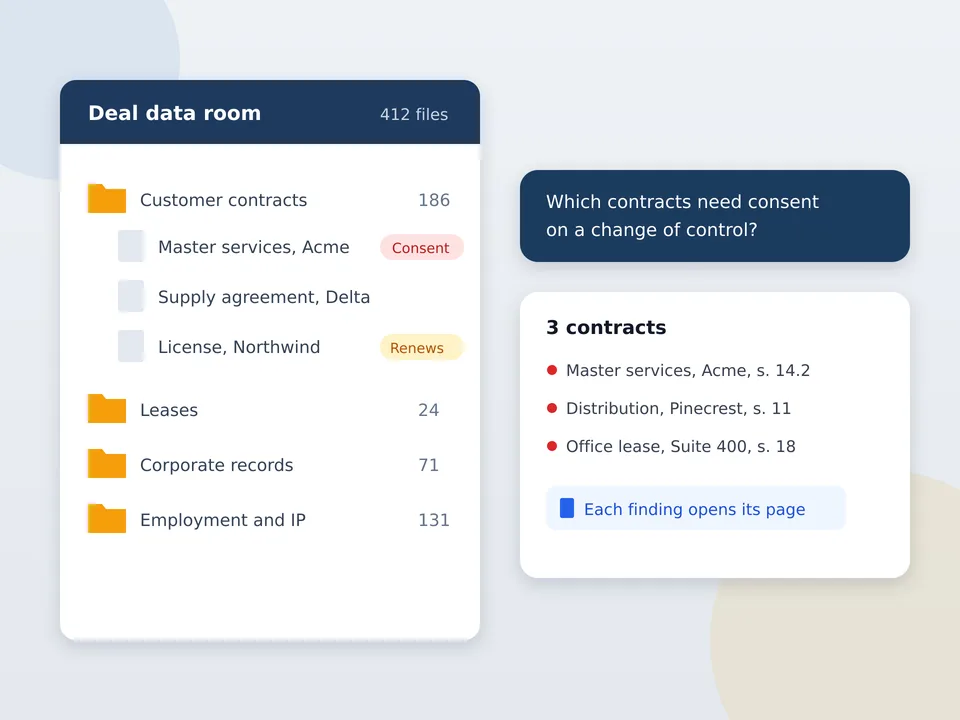
Upload the data room for one deal and ask it what a buyer needs to know. Which contracts need consent on a change of control, where the indemnity caps sit, what renews automatically. Every answer names the document and page it came from, at a price published on our site.
Competitor prices are third-party reports and labeled that way. CaseClerk prices are the ones on our pricing page.
Run diligence on your next data room
Drop in the contracts, leases and corporate records for one deal and ask across all of them. Every answer cites its source. 25 pages free, no card.
Free preview, no account needed: up to 3 files and 10 pages.
What is AI due diligence software?
AI due diligence software reads every document in a data room and answers questions about them with the source cited, so a lawyer can find the change of control clauses, assignment restrictions, indemnities and renewal terms without reading each file first. The attorney still owns the conclusions. The software removes the days spent locating the paragraph.
Most tools in this category, Kira, Luminance and Harvey among them, are sold by quote to large teams. CaseClerk publishes its price. You upload up to 1,000 files per deal, run key terms, obligations and risk reviews across all of them, and pay $99 to $499 a month by page volume.
- 1,000
- Files per deal in one CaseClerk matter vault
- 18
- File formats read, including scanned PDFs and spreadsheets
- $99
- CaseClerk Solo per month, published, 2,500 pages
- 0
- Enterprise diligence platforms above that print a price
What AI due diligence software has to do on a real data room
- Read the data room as one file
- Customer and vendor contracts, leases, the operating agreement, board minutes, the cap table spreadsheet and scanned signed originals go into one matter vault. Questions run across all of it at once.
- Cite the document behind every answer
- Each answer names the file and page, so the associate checking it opens one document instead of rereading forty. An answer you cannot trace is not diligence.
- Surface one-sided and risky clauses
- The risk review flags liability and indemnity terms, penalties, automatic renewal and anything one sided, each with the clause it came from.
- Pull key terms and obligations
- Parties, dates, amounts, notice periods and termination rights, plus what each side has to do and by when. The raw material for the diligence memo.
- Compare two versions side by side
- Put the signed agreement next to the amendment, or the seller's form against a customer's paper, and read where they agree, conflict or differ.
- Price you can put in the engagement letter
- Plans run $99, $249 and $499 a month by pages read. You can quote the client a technology cost before the data room opens.
How AI due diligence works in CaseClerk
-
1
Create a matter for the deal
One vault per transaction keeps the target's documents apart from every other client file.
-
2
Upload the data room export
Download the folders your data room NDA allows, then upload them. PDFs, Word, Excel, PowerPoint and image scans all read.
-
3
Run the reviews, then ask your own questions
Start with key terms, obligations and risks, then ask what the deal needs, such as which customer contracts require consent to assign.
-
4
Verify and write the memo
Open the cited page for each finding, confirm it, and carry it into your diligence memo or disclosure schedule.
AI due diligence software compared to the alternatives
There are five realistic ways to get through a data room. Each fails somewhere different, and CaseClerk is the wrong pick for some deals.
| Approach | Where it wins | Where it falls down | Typical US cost |
|---|---|---|---|
| Associates and paralegals read everything | Judgment on unusual terms, and a human owns every call | Slow, and the cost lands on a client who is watching the fee cap | $150 to $500 or more per hour of review |
| Enterprise diligence platforms (Kira, Luminance) | Trained clause extraction at scale, review grids, large team workflows | Sold by quote, often with implementation fees and multi-year terms, built for big review teams | Not published, reported in the tens of thousands a year |
| Legal AI platforms (Harvey, Legora) | Broad drafting, research and review under one contract | Seat minimums and enterprise sales cycles that rule out most small firms | Not published, reported around $1,200 per seat a month for Harvey |
| General AI chat | Cheap and fine for one pasted clause | Loses track across hundreds of files, answers vary between runs, and firm confidentiality settings need checking | $20 to $30 per user a month |
| CaseClerk | Reads the whole data room and cites the source of every answer, published price | No clause extraction grid, no spreadsheet export and no drafting. It is a reading tool, not a data room or a redliner | $99 to $499 a month by pages |
Competitor figures are third-party reports, not vendor price lists. Check each vendor before you budget.
Who uses CaseClerk for due diligence
Small firm deal lawyers on business acquisitions
Asset and stock purchases of local and regional businesses, often SBA financed, where the client will not pay for a week of associate reading and no enterprise vendor will sell you a seat.
Buy-side counsel checking customer contracts
Find every contract with a change of control trigger, anti-assignment clause, exclusivity or most favored nation term before the purchase agreement locks in reps and the disclosure schedule.
Real estate and lender diligence
Read the leases, estoppels, SNDAs and loan documents in one pass for rent, term, renewal options and assignment restrictions, with each answer tied to its page.
In-house teams on a small acquisition
A two-lawyer legal department buying a competitor gets the first pass done without a procurement cycle, then sends outside counsel the questions that need judgment.
Can AI do due diligence?
Yes for the reading, no for the judgment. AI can read a data room, locate the clauses a buyer cares about and summarize what each document says, with the source cited, in a fraction of the time manual review takes. It cannot decide whether a missing consent kills the deal or how to allocate that risk in the purchase agreement. That call stays with the lawyer.
The practical split on most deals is simple. The software does the first pass over everything, the associate verifies each cited finding, and the partner spends time on the few issues that matter. The reading drops from days to hours, and the memo is only as good as the checking behind it.
What is the best AI for legal due diligence?
For large firms running big deal teams, Kira and Luminance are the established diligence platforms, and Harvey covers diligence inside a broader enterprise contract. For a small or mid-size firm, the better question is which tool will sell to you at a price you can see. None of the enterprise options publish one.
| Tool | Built for | Price on its own site? | What is reported |
|---|---|---|---|
| Kira (Litera) | Large diligence teams, 1,400+ trained smart fields | No | $100 to $500 per user a month on directories, plus $10,000 to $30,000 implementation for smaller buyers. See our Kira pricing page |
| Luminance | In-house teams and firms on enterprise terms | No, and its AWS Marketplace listing is Private Offer Only | The widely quoted $42,857 is an average of revenue per customer, not a price. See Luminance pricing |
| Harvey | Large firms and legal departments | No | Around $1,200 per seat a month with a 20 to 25 seat floor, per third-party reports. See Harvey AI pricing |
| Thomson Reuters CoCounsel | Research plus document review inside Westlaw | No list price | Quote based, with 12% and 18% off 2 and 3 year terms |
| General AI chat (ChatGPT, Claude, Copilot) | One document or a pasted clause at a time | Yes | $20 to $30 per user a month on business tiers |
| CaseClerk | Small and mid-size firms reading a whole data room | Yes | $99, $249 or $499 a month by pages read, Enterprise quoted on request |
If your deal team already has a Kira grid workflow and a budget to match, keep it. If your deals are smaller and you need the reading done this week, a tool with a published price and cited answers gets you there without a sales cycle.
How much does AI due diligence software cost?
Enterprise diligence platforms do not publish prices, and the reported figures run from about $100 a user per month to tens of thousands a year before implementation. CaseClerk is priced on pages read, which tracks the size of the data room instead of the size of your firm. Here is roughly what that means per deal. Document and page counts vary widely, so size it to your own data room.
| Deal size (illustrative) | Documents | Pages to read | CaseClerk plan that covers it |
|---|---|---|---|
| Small business asset purchase | 80 to 150 | 1,500 to 2,500 | Solo, $99 for the month |
| Lower middle market stock purchase | 300 to 600 | 6,000 to 10,000 | Professional, $249 for the month |
| Carve-out or roll-up with many customer contracts | 800 to 1,000 | 20,000 to 30,000 | Firm, $499 for the month |
Plans bill monthly, and annual billing costs six months' price. On a deal billed to a client, a $249 month is usually less than one hour of associate time, which makes it easy to pass through or absorb.
How to use AI for due diligence on a small business acquisition
Small business deals are where AI changes the economics most, because the data room is real but the fee budget is not. A workable sequence for buy-side counsel:
- Get the index first. Ask the seller for the data room index and confirm the NDA lets you download and process the documents with a third-party tool.
- Upload by category. Material contracts, leases, corporate records, employment and IP, even if it all goes into one matter.
- Run the three reviews. Key terms, obligations and risks across everything, so you have a baseline before anyone reads a page.
- Ask the deal questions. Which contracts need consent to assign or on a change of control? Which customers can terminate for convenience? Where are the personal guarantees? Which leases expire within 24 months?
- Verify every finding you rely on. Open the cited page, confirm it, then move it into the memo or disclosure schedule.
The purchase price itself usually comes from a separate business valuation, and diligence findings such as a key customer contract that cannot be assigned are exactly what move that number.
Which contract risks should AI flag in M&A due diligence?
Point the software at the clauses that change what the buyer is actually getting. These are the questions worth asking on almost every deal:
- Change of control and anti-assignment. Which contracts need counterparty consent, and which terminate automatically.
- Exclusivity, non-compete and most favored nation terms that would bind the buyer after closing.
- Termination for convenience in major customer contracts, which caps what revenue is really worth.
- Indemnities and liability caps the target has given, and any that are uncapped.
- Automatic renewal and notice windows that fall in the first months after closing.
- IP ownership and assignment in contractor and development agreements.
- Personal guarantees and liens that must be released at closing.
CaseClerk's risk review surfaces the one-sided and exposure clauses on its own. The rest are plain English questions, and each answer points at the page.
Is it safe to upload a data room to an AI tool?
It can be, if the tool's terms fit your NDA and your confidentiality duty. Check three things before the first upload: whether the data room NDA permits processing the documents with a third-party service, whether the AI vendor trains models on your content, and how long it keeps it.
CaseClerk does not use your case documents to train any AI model of its own, and our privacy policy names the AI provider that processes them. Each deal sits in its own matter vault. The Firm plan offers confidentiality agreements for firms whose clients require one. Enterprise platforms often go further with custom retention and single sign-on, which is part of what their quotes pay for.
AI due diligence questions from deal lawyers
Will AI replace due diligence lawyers?
Can CaseClerk read a whole virtual data room?
Does CaseClerk produce a diligence memo or spreadsheet?
How accurate is AI due diligence review?
What is legal due diligence software?
Can I try AI due diligence before paying?
Get through the next data room this week
Upload the deal documents, run the reviews, and check the page behind every answer. Plans from $99 a month, trial on 25 pages with no card.
Start free trialKeep reading
AI contract review software
Read a whole set of agreements, amendments and side letters at once, with every answer sourced.
Kira pricing
Litera prints no Kira price. The reported per user range and what it means at 1, 3 and 10 users.
Luminance pricing
Private offers on 36 month terms, and what the most quoted figure really is.
LegalOn pricing
LegalOn prints no price. What the reported figures measure and why they disagree.
Harvey AI pricing
Reported seat prices, the seat floor and what Harvey costs at small firm sizes.
Pricing from $99 a month
Solo, Professional and Firm by pages read, Enterprise quoted on request.
Choose your plan
Put one matter in a vault and ask it the question you would ask a colleague
Sign up