For immigration lawyers buried in evidence packets
AI for Immigration Lawyers and Immigration Lawyer AI for Evidence Files
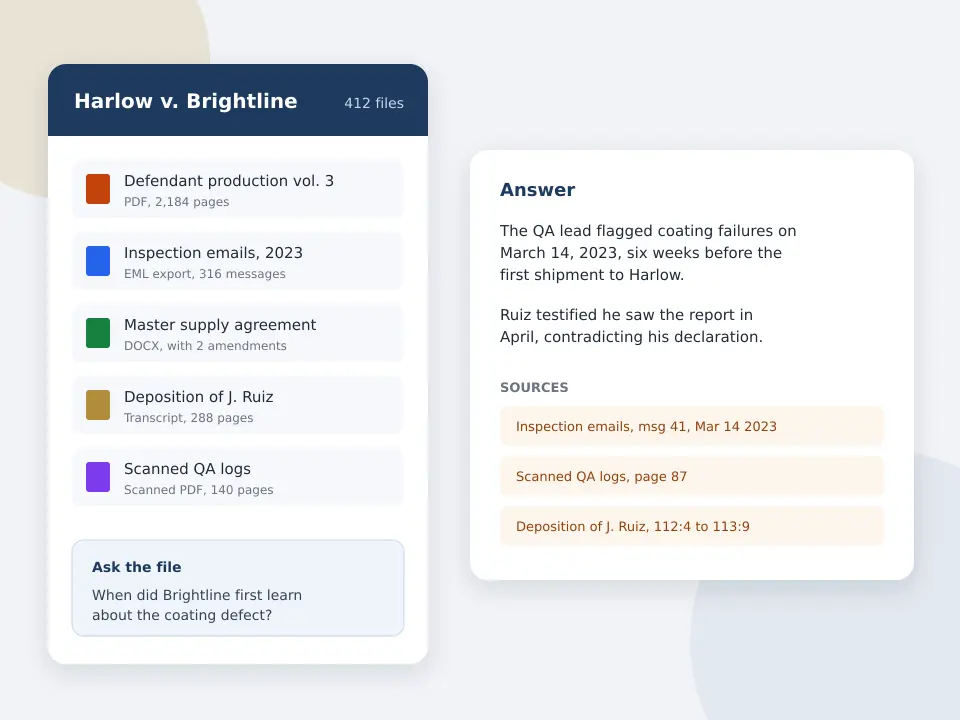
A marriage based adjustment file, an asylum case or an RFE response can mean hundreds of pages of declarations, tax transcripts, leases, bank statements, country condition reports and prior filings. CaseClerk reads the whole file, answers questions in plain English and names the document and page behind every answer, so you check facts before they go into a filing.
CaseClerk reads the documents you upload. It does not fill USCIS forms, file anything or give immigration advice. Plans and limits are the ones printed on the pricing page.
Test it on a file you already know
Upload evidence from an approved case and ask questions with known answers. Every answer names its source. After signup, try 25 pages across up to 5 files, no card.
Free preview, no account needed: up to 3 files and 10 pages.
What is the best AI for immigration lawyers?
The best AI for immigration lawyers is the one that reads the client's own evidence and cites the document and page for every answer. Form preparation software fills the I-130 or I-485, research tools find authority, but the hours go into reading the evidence packet. CaseClerk does that reading from $99 a month for 2,500 pages, with every answer tied to a page you can open.
- $99
- Solo monthly plan for 2,500 pages read
- Page cites
- Every answer names the document and page
- 1,000 files
- Per case, from declarations to tax transcripts
- 5 files
- Trial after signup, 25 pages, no card
What immigration AI has to do before you trust it with a client file
- Cite the document and page
- An answer that says the couple shared an address since 2023 is useless without the lease and the page. Every answer should point to a page you can open and quote.
- Find conflicts between documents
- Officers look for dates that do not match. The tool should show where the declaration, the I-130 answers, the lease and the tax return disagree on an address, a date or a name.
- Read scans and phone photos
- Clients send photos of leases and scanned bank statements. Confirm the tool reads scanned PDFs and images, then spot check one page by hand.
- Hold the whole file in one case
- Prior filings, the current packet and the RFE belong together. CaseClerk keeps up to 1,000 files in one case so answers draw on all of it.
- Keep client data out of model training
- Immigration files carry passports, A numbers and asylum claims. Check the privacy terms before you upload anything, and pick a tool that does not train on your documents.
- Flat price you can quote to a client
- Many immigration matters are flat fee. A flat monthly plan lets you price the reading into the fee instead of paying per user or per page.
How immigration lawyers use CaseClerk on an evidence packet
-
1
Upload the file as the client sent it
Add the declarations, prior forms, tax transcripts, leases, bank and insurance records, photos with captions, and the RFE or NOID if there is one.
-
2
Ask the officer's questions first
For example, which documents show a shared address and for which months, and where does any document give a different date of marriage.
-
3
Open every cite before you use it
Each answer names the document and page. Read the passage in context before it goes into a cover letter, a brief or an RFE response.
-
4
Build the exhibit list from the answers
Turn the sourced answers into an index of exhibits by issue, so the response tracks each point the officer raised.
AI options for an immigration practice and where each wins
Immigration firms mix tools. Form platforms prepare and track petitions, research tools find authority and policy, and a reader answers questions about the evidence. CaseClerk is the reader, priced flat. Each other category wins at its own job.
| Immigration form and case platforms | Immigration research AI | General chat assistants | CaseClerk | |
|---|---|---|---|---|
| Main job | Fill forms, track cases, client portal | Find law, policy and precedent | Draft and brainstorm | Answer questions about the documents you hold |
| Reads your evidence packet | Stores it, light reading | Limited, research first | Short files, pasted text | Yes, up to 1,000 files per case |
| Cites the source page | Varies | Cites authorities | Rarely reliable | Yes, document and page |
| Typical price model | Per user per month | Per user, often by quote | Per user per month | Flat monthly, $99 to $998 |
| Best for | Running the petition pipeline | Briefing the law | First drafts | Checking facts across the file |
| Where it wins | Form accuracy and deadlines | Authority and policy updates | Writing speed | Price and cited answers across the file |
Where immigration lawyers use a cited reader
Marriage based petitions
Map every document that shows commingled finances or a shared address, by month, with the page behind each one.
RFE and NOID responses
Match each point in the notice to the evidence already in the file, and see which points have nothing behind them yet.
Asylum declarations
Check the client's declaration against the I-589, prior statements and the country reports for dates, places and names that do not line up.
Removal defense files
Read the record of proceedings, prior applications and criminal dispositions in one case and ask where the facts differ.
Why evidence reading is the bottleneck in an immigration practice
The forms are rarely what keeps an immigration lawyer up at night. Form platforms already fill the I-130, I-485 and I-765 from one questionnaire. What takes the hours is reading what the client sent and making sure it says what the petition claims. USCIS officers do the same reading, and a date that does not match across two documents is enough to trigger a request for evidence or an interview question you did not prepare for.
The burden sits with the petitioner. Under 8 CFR 103.2, the officer can deny or issue an RFE when the evidence does not establish eligibility, and the USCIS Policy Manual describes what officers look for in each benefit type. A careful read of the packet before filing is the cheapest insurance a flat fee matter can buy, and it is exactly the work that does not scale when a paralegal is reading 400 pages by hand.
CaseClerk is built for that read. You upload the file, ask the questions an officer would ask, and each answer comes back with the document and page so you can verify it in seconds. It does not replace the form software or the research subscription. It sits beside them, the way legal document review software sits beside a case management system in a litigation firm.
A worked example with a marriage based adjustment file
Take a spousal adjustment case. The client sends two declarations (8 pages), the prior I-130 and I-485 drafts (46 pages), three years of IRS tax transcripts (18 pages), two leases (14 pages), 24 months of joint bank statements (96 pages), a health insurance enrollment (6 pages), a car title and insurance cards (5 pages), and 60 pages of photos with captions and messages. That is 253 pages, inside the 2,500 pages a month on the $99 Solo plan, so a solo can run about nine files of that size in a month.
Questions that pay for themselves on a file like this:
- Which documents show both spouses at the same address, and for which months?
- Does any document give a different date of marriage or a different date the couple moved in together?
- Do the tax transcripts show married filing jointly for every year the declaration says they did?
- Is there any month in the bank statements with no shared transactions?
- Where does the declaration mention a prior marriage, and is the divorce decree in the file?
Every answer names the document and page. You open each one, confirm the wording, and only then put it into the cover letter or the interview prep notes. The evening of reading becomes the time it takes to verify the cites. If the file goes to an interview or a hearing, a dated view of the same evidence helps, see legal timeline software.
What the reading costs on each plan
Immigration practices bill flat fees, so the reading cost has to be known in advance. The table uses the 253 page file above as a typical matter and our printed plan limits.
| Plan | Monthly price | Pages a month | Files of 253 pages | Reading cost per file |
|---|---|---|---|---|
| Solo | $99 | 2,500 | 9 | about $10 |
| Professional | $249 | 10,000 | 39 | about $6.30 |
| Firm | $499 | 30,000 | 118 | about $4.20 |
| Enterprise | $998 | 60,000 | 237 | about $4.20 |
Annual billing costs six months of the monthly price, which halves each figure. Compare that with the paralegal hours a 253 page read takes, and the decision is usually made by the first RFE you avoid. Full limits are on the pricing page.
Asylum and removal files need a different set of questions
In asylum work the risk is inconsistency. The declaration, the I-589, the credible fear notes, prior border statements and the country condition reports all describe the same events, and a judge or asylum officer will compare them. Upload them into one case and ask where dates, places, names of persecutors or the sequence of events differ. Each difference comes back with both pages, so you can prepare the client to explain it rather than discover it at the hearing.
Country condition reports are long. Ask which passages describe treatment of the client's particular group in the region they named, and get the report and page for each passage so the brief quotes the source directly.
Removal defense adds criminal records, prior applications and the record of proceedings. The same method works there. Ask which disposition documents show the statute of conviction and the sentence, and check them against what the prior applications said. Firms that also handle criminal matters can read about the same approach on our page on AI for criminal defense lawyers.
What CaseClerk does not do in an immigration case
Be clear about the limits before you buy. CaseClerk does not fill USCIS forms, does not e-file, does not track receipt notices or priority dates and does not give legal advice. Keep your form platform for that. It does not translate documents either, so foreign language records need a certified translation, which USCIS requires anyway, and you upload the translation.
Client intake and consultations stay where they are. If booking consultations eats your mornings, a scheduler such as Calendarmeeting handles the booking page and reminders, and CaseClerk takes over once the documents arrive.
Questions immigration lawyers ask about AI
What is the best AI for immigration lawyers?
Can AI help with RFE responses?
Is it safe to upload immigration client files to AI?
Does CaseClerk fill out USCIS forms?
How much does AI for an immigration law firm cost?

Read your next evidence packet with cited answers
After signup, try 25 pages across up to 5 files, no card. Ask the officer's questions and open every source. Plans from $99 monthly.
Start free trialKeep reading
Legal document review software
Cited answers across a whole production.
Legal timeline software
A dated chronology with every event cited.
AI for criminal defense lawyers
Discovery reading for defense practices.
Clio alternatives
What a reader beside case management costs.
PracticePanther pricing
Per user plans for running the office.
Choose your plan
Put one matter in a vault and ask it the question you would ask a colleague
Sign up