For attorneys who need a sourced summary, not a vague one
AI Legal Document Summarizer That Cites the Page for Every Point
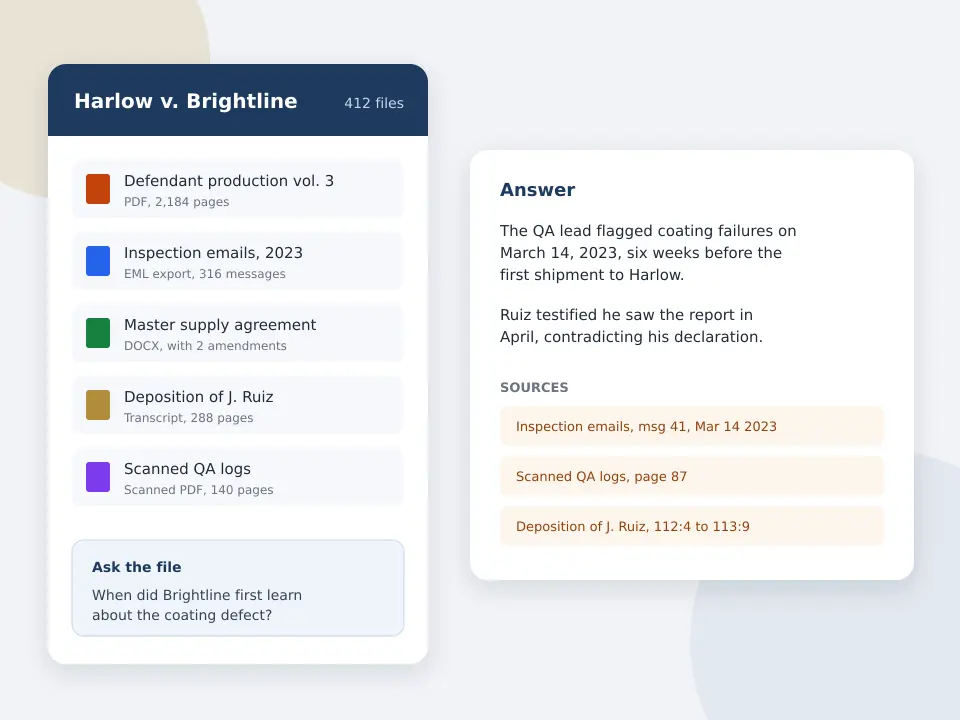
CaseClerk is an AI legal document summarizer that reads the documents in a matter and answers with a summary that names the document and page behind each point. Upload pleadings, contracts, records or a production, ask for a summary of what you need, and open the cited page to confirm it. It costs a flat $99 a month for 2,500 pages.
CaseClerk summarizes the documents you upload. It does not file anything, research case law or give legal advice, and a person checks every cited page. Plans and limits are the ones on the pricing page.
Summarize one real file
Upload a contract, a records set or a production you already know and ask for a summary. Check each point against the cited page. After signup, try 25 pages across up to 5 files, no card.
Free preview, no account needed: up to 3 files and 10 pages.
What does an AI legal document summarizer do?
An AI legal document summarizer condenses long legal documents into the points you asked for and shows where each point comes from. A good one summarizes by question (the termination terms, the treatment dates, what a witness said) rather than producing one generic paragraph. CaseClerk does this across every document in a matter, with the document and page named for each point, from $99 a month for 2,500 pages.
- $99
- Solo monthly plan, 2,500 pages read
- Page cites
- Each summary point names document and page
- $249
- Professional, 10,000 pages a month
- 5 files
- Trial after signup, 25 pages, no card
What a legal summary needs before you can use it
- A source for every point
- A summary you cannot trace is a risk. Each point should open to the document and page so you can check it in seconds.
- Summaries by question
- Ask for the payment terms, the dates of treatment or the testimony on one topic. A targeted summary beats a generic abstract you still have to dig through.
- Across the whole matter
- The useful summaries cut across documents, such as every place a figure appears. The reader searches the full matter, not one PDF at a time.
- Where documents disagree
- Ask where two documents give different dates or amounts and see both sources side by side.
- Scans and PDFs
- Upload the documents as received, scans included, and keep adding to the matter as more arrive.
- Flat account price
- You pay by pages read each month, not per user, so a second reader on the matter does not add a seat.
How a summary gets built in CaseClerk
-
1
Upload the documents
Add the contract, records, correspondence or production for the matter in a case vault.
-
2
Ask for the summary you need
For example: summarize the indemnity and termination terms in each agreement, or list the treatment dates and providers.
-
3
Open the cited pages
Click each source for the points you will rely on. Checking is faster than reading cold.
-
4
Pass on a sourced summary
Export the answer with its citations so the next reader can verify it too.
Summary requests and what you get back
Summaries work best when the request is specific. These are typical requests firms put to a matter and what the answer should contain.
| Request | What you ask | What comes back |
|---|---|---|
| Contract terms | Summarize termination, payment and assignment terms in each agreement | One line per agreement with the page for each term |
| Medical records | List treatment dates, providers and charges | A dated list with the page for each entry |
| Testimony | What did the witness say about the meeting | Passages from the transcript with page and line context |
| Production | Which documents mention this amount and who sent them | The documents and pages where it appears |
| Conflicts | Where do the two accounts differ on dates | Both sources side by side |
Answers are first drafts checked by a person against the cited page. CaseClerk facts from caseclerk.ai/pricing.
Where firms use a legal summarizer
Contract portfolios
Summarize key terms across a stack of agreements and see which ones differ.
Records and billing
Condense a records set into a dated list ready for a demand or chronology.
Transcripts and exhibits
Summarize what was said on a topic and check it against the exhibits.
Intake packets
Give the attorney a sourced first page of facts before the first call.
What a hand summary of 600 pages costs
Take a 600 page records file. If a paralegal needs about three hours per 100 pages to read and summarize carefully, and the loaded cost is $40 an hour, that is 18 hours and $720. Those figures are assumptions, so substitute your own.
The same file is 600 of the 2,500 pages a month on Solo at $99. The paralegal still spends time, but on the pages the answers point to. Try the ratio on a closed file before you trust it on a live one.
Who it is for and who it is not for
It is for attorneys, paralegals and small firms who read long files and need summaries they can check. It suits contract stacks, records, productions and transcripts.
It is not for case law research, drafting pleadings, or anyone who wants a summary they will not verify. CaseClerk does not transcribe audio or video, and a person must confirm every cited page. For the ethics side, see the ABA Formal Opinion 512 on generative AI.
Pick one recurring summary job first
Firms that get value start with one job, such as intake packets or records, and measure hours before and after. If unsure which, see our AI paralegal page, deposition summary software for transcripts and medical record review for records.
Questions about AI legal document summarizers
What is the best AI to summarize legal documents?
Can AI summarize a long legal document accurately?
How much does an AI legal document summarizer cost?
Is it safe to upload client documents to an AI summarizer?
Can it summarize medical records and contracts?

Get a sourced summary of your next file
After signup, try 25 pages across up to 5 files, no card. Ask for the summary you need and open every source. Plans from $99 monthly.
Start free trialKeep reading
AI paralegal
Reading, chronology and cited answers for a small firm.
Legal document review software
Cited answers across a whole production.
Deposition summary software
Page cited testimony answers.
Medical record review for attorneys
Cited answers across a records file.
Contract review software for law firms
Key terms pulled from agreements with pages.
AI for small law firms
A worked month and what each option costs.
Choose your plan
Put one matter in a vault and ask it the question you would ask a colleague
Sign up