For firms where paralegal hours disappear into reading
AI Paralegal for Law Firms That Reads the Case File and Cites Every Page
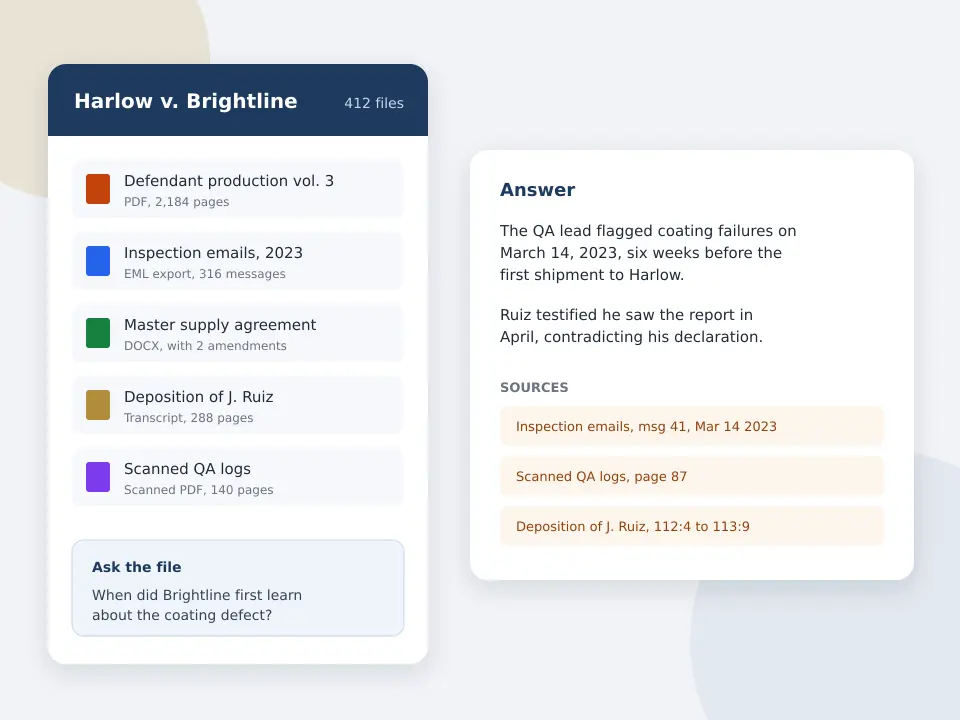
An AI paralegal is useful when it does the part of the job that eats the week: reading the file. CaseClerk reads every document in a matter, answers questions in plain English and names the document and page behind each answer, so your paralegal opens the source and confirms it instead of searching for it. It costs a flat $99 a month for the account, not a salary or a seat.
CaseClerk reads the documents you upload. It does not file anything, draft pleadings or give legal advice, and a person checks every cited page. Plans and limits are the ones printed on the pricing page.
Give the AI paralegal one real matter
Upload the pleadings, records or production from a matter you know and ask the questions a paralegal gets asked. Every answer names its source. After signup, try 25 pages across up to 5 files, no card.
Free preview, no account needed: up to 3 files and 10 pages.
What does an AI paralegal actually do?
An AI paralegal reads the documents in a matter and answers questions about them with a citation to the page. It finds the date a document was signed, lists every mention of a witness, compares two accounts of the same event and builds a dated chronology from the file. It does not replace the judgment, filing, client contact or ethics duties that stay with your staff and attorneys. CaseClerk does the reading from $99 a month for 2,500 pages.
- $99
- Solo monthly plan for 2,500 pages read
- Page cites
- Every answer names the document and page
- $249
- Professional, 10,000 pages a month
- 5 files
- Trial after signup, 25 pages, no card
What a firm should require before an AI paralegal touches a client file
- A citation on every answer
- A summary your paralegal cannot trace back to a page is a liability. Each answer should open to the document and page so it can be checked in seconds.
- Whole matter, not one file at a time
- The questions that cost hours cut across documents: who knew what and when. The reader searches the full matter, not a single PDF.
- Conflicts between documents
- Ask where a declaration and the records disagree on a date or an amount and see both sources side by side.
- Dated chronology on request
- Turn the file into a date ordered list with a source for each entry, the first draft a paralegal would otherwise type by hand.
- Confidentiality you can show a client
- Your uploads are not used to train models, and an account confidentiality agreement is available on the site for firms that need one in writing.
- Flat account price
- No per seat fee when a second paralegal or a new associate joins the matter. You budget from the plan, not from headcount.
How a paralegal works with CaseClerk on a new matter
-
1
Upload what arrived
Add pleadings, correspondence, records, contracts or the production as received. Scans and PDFs are read, and you can keep adding documents.
-
2
Ask the first-week questions
Who are the people and companies, what are the key dates, which documents mention the amount in dispute, what is missing from the file.
-
3
Open every cited page
Click through to the source for each answer you plan to rely on. The paralegal's job becomes verification, which is faster than searching.
-
4
Hand the attorney a sourced summary
Export the answers and chronology with their citations. The attorney reads a page of facts with sources, not a stack of unsorted PDFs.
AI paralegal options and where each one wins
Firms mix three kinds of help. A person is irreplaceable for judgment and client work, a legal AI suite covers research and drafting, and a cited reader handles the reading. This table is for deciding which hours to move.
| Hiring a paralegal | Per seat legal AI suite | General chat assistant | CaseClerk | |
|---|---|---|---|---|
| Main job | Everything in the matter | Research, drafting, review | Brainstorming, first drafts | Answer questions about the documents you hold |
| Reads a full matter | Yes, slowly | Varies by product | Short files, pasted text | Yes, across all documents in a case |
| Cites the source page | If asked to | Varies | Rarely reliable | Yes, document and page |
| Cost model | Salary and benefits | Per user, often by quote | Per user per month | Flat monthly, $99 to $998 |
| Best for | Judgment, filing, client contact | Legal research and drafting | Rough wording | Cutting reading time and checking facts |
CaseClerk facts from caseclerk.ai/pricing. Other categories described in general terms; check each vendor before buying.
Where firms put the AI paralegal to work
Discovery and productions
Find every document that mentions a person, date or amount in a production and read the passage with its page, instead of keyword hits with no context.
Deposition and transcript prep
Ask what a witness said about a topic across transcripts and exhibits, and check the testimony against emails and records.
Medical and billing records
List treatment dates, providers and charges from a records set with the page for each, ready for a demand or a chronology.
Contract files and due diligence
Pull the termination, payment and assignment terms from a stack of agreements and see where they differ.
What one paralegal hour of reading costs
Reading is the largest hidden cost in a small firm because it never gets its own line on an invoice. Take a 1,200 page production. If a paralegal needs about three hours to digest each 100 pages carefully, and the loaded cost is $40 an hour, that is 36 hours and $1,440 before anyone asks a question of it. Those figures are assumptions, so substitute your own.
A 1,200 page production fits well inside the 2,500 pages a month on Solo at $99. The paralegal still spends time, but on the 20 or 30 pages that matter, opened from cited answers. If that cuts the reading to a third, the firm gets back 24 hours on one matter, about $960 at the same rate, against a $99 plan. Test the ratio on a closed file before you trust it on a live one.
Where an AI paralegal stops
Be clear with your team about the limits. CaseClerk does not file documents, calendar deadlines, talk to clients or decide strategy, and it can be wrong, which is why every answer carries a page to check. Treat output as a first pass reviewed by a person, the same standard you would apply to a new hire's work. For the ethics side, the ABA's Formal Opinion 512 on generative AI covers competence, confidentiality and supervision, and applies to non-lawyer staff using these tools too.
Pick the reading job first, then the tool
Firms that get value start with one recurring reading job, such as intake packets, productions or records, and measure hours before and after. If you are not sure which job costs the most, a short workflow review with an assessment platform like Assessmentcloud can score how your intake and review process runs today. Then compare the reading tools against that job. Litigation teams can start with AI for litigators and deposition summary software, and the legal document review software page shows the production workflow with a worked file.
Questions about using an AI paralegal
Can AI replace a paralegal?
What is the best AI paralegal software for a small law firm?
Is it safe to upload client documents to an AI paralegal?
How much does an AI paralegal cost?
Can an AI paralegal summarize depositions and medical records?

Put the reading on an AI paralegal and keep the judgment
After signup, try 25 pages across up to 5 files, no card. Ask your first-week questions and open every source. Plans from $99 monthly.
Start free trialKeep reading
AI for litigators
Productions and transcripts read with cited answers, with a worked file.
Legal document review software
Cited answers across a whole production.
Case chronology software
Dated events read from the file, each one cited.
Deposition summary software
Page cited testimony answers checked against the records.
Choose your plan
Put one matter in a vault and ask it the question you would ask a colleague
Sign up