For firms of 2 to 20 lawyers that read more than they bill
AI for Small Law Firms That Reads the Case File and Cites Every Page
AI for small law firms pays off fastest on the reading: productions, medical records, transcripts and contracts. CaseClerk reads every document in a case and answers your questions with the document and page, for a flat $99 to $998 a month per account instead of a per lawyer seat.
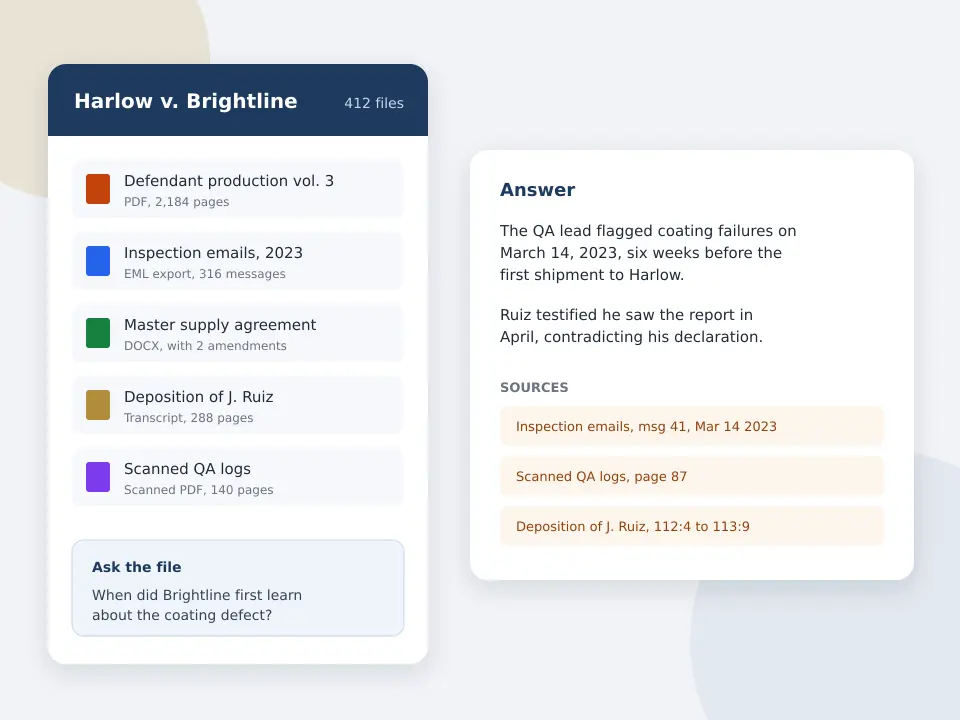
CaseClerk reads the documents you upload and cites the page for each answer. It does not file, draft pleadings or give legal advice, and a lawyer checks every cited page. Plans and limits are the ones printed on the pricing page.
Try it on a closed matter you know well
Upload the file from a case your firm already finished and ask the questions you remember answering by hand. Check every cited page against what you know.
Free preview, no account needed: up to 3 files and 10 pages.
What is the best AI for small law firms?
The best AI for a small law firm is the one that removes the hours nobody bills: reading the case file. Practice management AI helps with intake and billing, research AI helps with case law, but most small firm time goes into reading what the other side produced and what the client sent. CaseClerk reads the whole file and answers with the document and page. Plans start at $99 a month for 2,500 pages, priced per account, so a firm does not pay again for every lawyer and paralegal who opens the file.
- $99
- Solo, 2,500 pages read a month
- $249
- Professional, 10,000 pages a month
- Per account
- Not billed per lawyer seat
- Page cites
- Every answer names the document and page
What a small firm should check before buying legal AI
- A citation on every answer
- An answer you cannot trace to a page cannot go in a letter, a brief or a client call. Each CaseClerk answer names the document and page so the lawyer can open it and read the original.
- Price that does not scale with headcount
- Per seat tools charge again for each paralegal and associate. Small firms share files across three or four people, so a flat account price usually lands lower than seats for the same work.
- The whole matter, not one pasted document
- Upload pleadings, records, emails, spreadsheets and scans into one case vault and ask across all of them at once, instead of pasting pages into a chat window one at a time.
- Scans and mixed formats
- Client files arrive as scanned PDFs, Word drafts, Excel exports and email. CaseClerk reads PDF, DOCX, XLSX, PPTX, EML, MSG and images, including scanned pages.
- A page allowance you can plan around
- Plans are sized in pages read a month: 2,500, 10,000, 30,000 or 60,000. Count the pages your firm receives in a busy month and pick the plan that covers it.
- No migration
- CaseClerk sits beside the practice management system you already run. You keep Clio, MyCase or Smokeball for billing and calendars and add a reader for the documents.
How a small firm starts with CaseClerk
-
1
Pick one closed matter
Choose a finished case where you already know the answers. That gives you a fair test of accuracy before any live client file goes in.
-
2
Upload the file as it came
Add the production, records or contracts in the formats you received them. No renaming or splitting is needed first.
-
3
Ask the questions you answered by hand
When did the client first complain in writing? Which emails mention the change order? What did each witness say about the meeting? Open each cited page.
-
4
Measure the hours
Compare the time the matter took the first time with the time it takes now. If the ratio holds on two or three closed files, move live matters over.
AI options for small law firms and where each one wins
Small firms usually end up with two or three tools, not one. The question is which job each one does and what it costs as the firm grows from three people to eight.
| Practice management AI | Legal research AI | General chat assistant | CaseClerk | |
|---|---|---|---|---|
| Main job | Intake, billing, time entries | Case law, statutes, drafting | Rough wording and brainstorming | Reading the documents in your case |
| Reads a full case file | Limited to what sits in the system | Not its focus | Short files, pasted text | Yes, every document in the vault |
| Cites the source page | Varies | Cites authorities | Not reliable | Yes, document and page |
| Cost model | Per user, add on to the subscription | Per user, often from about $100 to $550 a month | Per user per month | Flat $99, $249, $499 or $998 a month per account |
| Best for | Running the practice | Finding and checking law | Wording a first draft | Cutting reading time on facts |
CaseClerk prices from caseclerk.ai/pricing. Research price range from Thomson Reuters starting prices for Westlaw and CoCounsel Legal on its small firm page, checked November 2026. Check each vendor before buying.
Where small firms put AI to work first
Discovery productions
Find every document that mentions a person, a date or an amount in a production of a few thousand pages, with the page cited, before the meet and confer.
Medical records in injury cases
Pull treatment dates, providers and complaints from records and bills into a dated list you can check line by line.
Deposition preparation
Ask what a witness said about a topic across prior transcripts and exhibits and get each passage with its page.
Contracts and leases
Find renewal dates, notice periods, assignment clauses and payment terms across a stack of agreements in one pass.
A worked month for a five person firm
Take a firm with three lawyers and two paralegals doing employment and commercial litigation. In a normal busy month the files that arrive look like this:
| Material received | Pages |
|---|---|
| Defendant document production, one wage and hour case | 1,800 |
| Medical and personnel records, one retaliation claim | 900 |
| Four deposition transcripts with exhibits | 600 |
| Commercial lease set and amendments for a client dispute | 150 |
| Total | 3,450 |
3,450 pages is above the 2,500 on Solo, so this firm belongs on Professional at $249 a month (10,000 pages), or $1,494 a year on the yearly plan, which charges six months for twelve. One account covers everyone who reads the files.
Now the alternative. A per seat legal AI suite bought for the three lawyers at a starting price of $551.85 per user per month, the published starting figure for CoCounsel Legal on the Thomson Reuters small firm page, comes to $1,655.55 a month before any paralegal seat. That suite does research and drafting that CaseClerk does not do, so the honest comparison is the job: if the firm already has research covered, the reading is the gap, and a flat reader costs a fraction of another set of seats. Our Westlaw pricing breakdown shows the research side for one and three attorneys.
The time side, with assumptions you should replace with your own: if a paralegal digests about 100 pages in three careful hours at a loaded cost of $40 an hour, 3,450 pages is roughly 104 hours and $4,140 of reading a month. Cutting that to a third, by reading only the pages that cited answers point to, returns about 69 hours. Test the ratio on a closed file before you count on it.
Is AI worth it for a small law firm?
Yes, when it replaces work you cannot bill or bill at a discount. Flat fee and contingency matters are the clearest case: every hour saved on reading is margin, because the fee does not change. Hourly matters still benefit, since clients increasingly push back on large blocks of document review time.
It is not worth it when the tool needs a person to retype its output or check it without a source. That is why the citation matters more than the summary. If your team has to search the file again to confirm an answer, the tool has saved nothing.
Small firms also win on speed of adoption. There is no committee and no procurement process, so a partner can test a tool on a closed matter this week and decide by Friday. Firms already paying for an AI paralegal style reader often find the next bottleneck is client work outside litigation, such as answering a corporate client's outside counsel request, where software that turns an RFP into a proposal handles the response packet while the lawyers handle the matter itself.
Ethics and confidentiality for small firms using AI
ABA Formal Opinion 512 sets the baseline for generative AI: understand what the tool does, protect client information under Rule 1.6, supervise its output and bill fairly for the time it saves. State bars have added their own guidance on top, so check yours.
In practice that means three things for a small firm. Know where uploaded files go and whether they train a model. Keep a person responsible for every answer that leaves the office. Do not bill hours that the tool removed. CaseClerk keeps each case in its own vault, answers only from the files you upload and shows the page so the reviewing lawyer can confirm it. For the full document review workflow, see our legal document review software page, and for trial work, AI for litigators walks through a 2,002 page production.
Questions small firms ask about legal AI
What is the best AI for small law firms?
How much does AI cost for a small law firm?
Can a solo or small firm use AI ethically?
Does CaseClerk replace practice management software?
How many pages does a small firm need a month?

Put the reading on CaseClerk and keep the judgment in house
After signup, try 25 pages across up to 5 files, no card. Ask the questions from a closed matter and open every source.
Start free trialKeep reading
AI paralegal
What a paralegal hour of reading costs and how a cited reader changes it.
Legal AI pricing comparison
Which legal AI vendors publish prices and what each one charges.
Clio alternatives
Per user practice management costs for a five person firm.
Deposition summary software
Transcripts and exhibits read with page cited answers.
Choose your plan
Put one matter in a vault and ask it the question you would ask a colleague
Sign up