For litigators reading productions, transcripts and records
AI for Litigators and AI for Litigation Files With Cited Answers
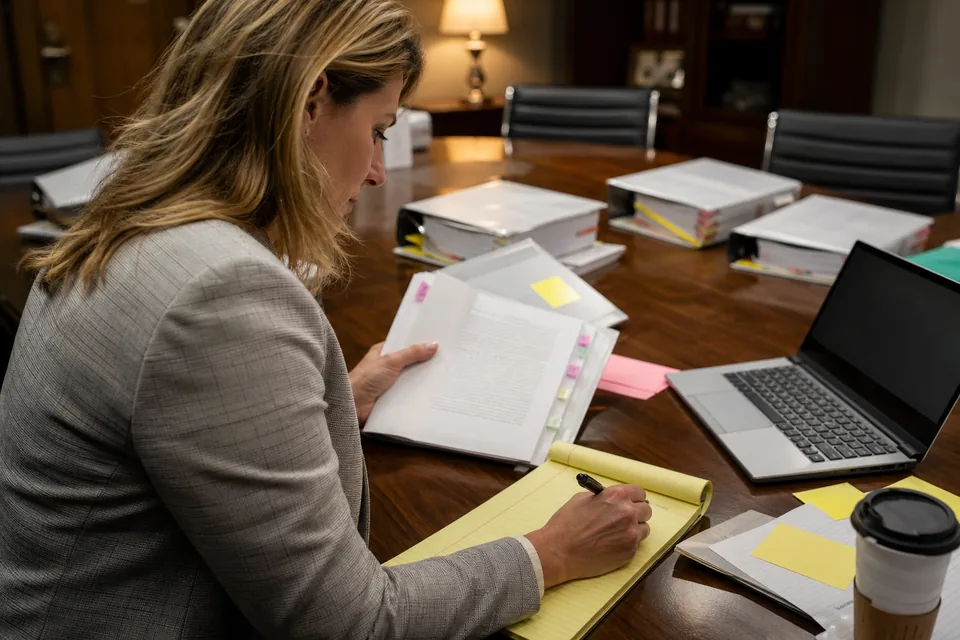
Litigation is a reading job before it is a writing job. A production of emails, a stack of deposition transcripts and the other side's exhibits all have to be read before the motion or the trial outline is worth anything. CaseClerk reads the whole case file and answers your questions with the document and page behind every answer, so you verify in seconds instead of searching for hours.
CaseClerk reads the documents you upload and cites them. It is not a legal research database, does not file anything and does not replace your judgment. Plans and limits are the ones printed on the pricing page.
Test it on a closed matter
Upload a production or transcript from a case you know well and ask questions with known answers. Every answer names its source. After signup, try 25 pages across up to 5 files, no card.
Free preview, no account needed: up to 3 files and 10 pages.
What is the best AI for litigators?
The best AI for litigators is the one that reads your own case file and cites the document and page for every answer. Research tools find the law. Drafting tools write first drafts. The hours in a litigation practice go into reading productions, transcripts and records, and that is where a cited reader pays for itself. CaseClerk does that from $99 a month for 2,500 pages, flat, not per user.
- $99
- Solo monthly plan for 2,500 pages read
- Page cites
- Every answer names the document and page
- 1,000 files
- Per case, from emails to transcripts
- 20 formats
- PDF, Word, email, scans and more
What litigation AI has to do before you rely on it
- Cite the document and page
- An answer that says the CFO knew about the defect in March is worthless in a brief without the email and the page. Every answer should point to a source you can open and quote.
- Read the whole file, not one document
- The useful questions cut across a production, a transcript and an exhibit at once. The tool has to hold all of them in one case, up to 1,000 files.
- Find contradictions
- Testimony that does not match the documents is where cases turn. Ask where a witness differs from the emails and get both pages back.
- Put events in order
- Ask for a dated sequence of what happened and who knew what, with a cite for every entry, ready for the statement of facts.
- Say when the file is silent
- A reliable reader tells you when nothing in the file answers the question, instead of filling the gap with a guess.
- Keep client files private
- Documents stay in your account, are not used to train models and can be deleted with the case when the matter closes.
How litigators use CaseClerk on a production
-
1
Upload the case file
Add the production, deposition transcripts, pleadings, expert reports and your client's own documents to one case.
-
2
Ask the questions you would ask an associate
Who knew about the problem and when, which emails mention the termination, where the witness contradicts the incident report.
-
3
Open every cited page
Each answer names the document and page. Check the wording against the original before anything goes into a filing.
-
4
Build the outline from verified facts
Use the cited answers for the motion, the deposition outline or the trial binder, with the source next to each fact.
AI litigation tools and where each one wins
Litigation teams use several kinds of AI, and each wins at a different job. Research platforms find authority, ediscovery platforms run large reviews, drafting assistants write. CaseClerk is the reader for the documents you already hold, priced flat. The honest table:
| Legal research AI | Ediscovery platforms | General chat assistants | CaseClerk | |
|---|---|---|---|---|
| Main job | Find and summarize case law | Process, review and produce large data sets | Draft and brainstorm | Answer questions about your case documents |
| Reads your own case file | Limited uploads | Yes, built for review at scale | Short files, pasted text | Yes, up to 1,000 files per case |
| Cites the source page | Cites authorities | Tags and coding, not answers | Rarely reliable | Yes, document and page |
| Typical price model | Per user, often by quote | Per GB hosted plus users | Per user per month | Flat monthly, $99 to $998 |
| Best for | Briefing the law | Productions in the hundreds of GB | First drafts | Small and mid-size matters, fast fact finding |
| Where it wins | Authority and citators | Privilege review and production | Writing speed | Price and cited answers across the file |
Where litigators use a cited reader
Commercial and contract disputes
Find every email that discusses the delay, the notice or the change order, with the date and page, before you draft the breach section.
Employment litigation
Check the stated termination reason against performance reviews, HR emails and the handbook, and find the earliest mention of the complaint.
Personal injury and insurance
Read medical records, claim files and adjuster notes together and ask where the treatment history differs from the testimony.
Deposition preparation
Ask what the witness said about each topic in prior testimony and which documents they authored, then build the outline from the cites.
Why reading is where litigation hours go
Ask a litigator where the week went and the answer is rarely the brief. It is the reading behind it. A mid-size commercial case can produce a few thousand pages of emails and attachments, three or four deposition transcripts of 200 pages each, and expert reports with their own exhibits. Every fact in the motion has to trace back to one of those pages, and the partner or the judge will check.
That is also where AI has already burned lawyers. Courts have sanctioned filings that cited cases that do not exist, and the ABA Formal Opinion 512 says lawyers must verify what a generative AI tool produces before relying on it. A tool that answers about your own file with the document and page makes that verification quick: you open the cite and read it. A tool that answers without a source makes you redo the reading.
CaseClerk is built for that one job. It does not research the law and does not run privilege review on a 300 GB production. It reads the case file you upload and answers questions with sources. For the larger review platforms and how their per GB pricing compares, see our page on ediscovery software for small law firms.
A worked example with a breach of contract production
Take a supply contract dispute. The other side produces 1,140 pages of emails and attachments. You hold the contract and amendments (42 pages), your client's own emails (310 pages), two deposition transcripts (226 and 188 pages) and the opposing expert's report with exhibits (96 pages). That is 2,002 pages, inside the 2,500 pages a month on the $99 Solo plan.
Questions that pay for the month on a file like this:
- Which emails mention the late delivery before the date the defendant says it first learned of it?
- Where does the operations manager's testimony differ from what the emails show about the change order?
- Which documents refer to the notice and cure clause, and was written notice ever sent?
- What does the expert report rely on, and which of those documents are actually in the production?
- Give a dated sequence of every communication about the price increase, with the author of each.
Every answer names the document and page. You open each one and confirm the wording before it goes into the statement of facts or the deposition outline. For deposition work specifically, our page on deposition summary software goes further into transcripts, and legal timeline software covers building the chronology.
What reading a case file costs on each plan
Litigation budgets are watched closely, especially on contingency and fixed fee matters, so the reading cost should be known before the case starts. The table uses the 2,002 page production above as a typical mid-size matter and our printed plan limits.
| Plan | Monthly price | Pages a month | Matters of 2,002 pages a month | Reading cost per matter |
|---|---|---|---|---|
| Solo | $99 | 2,500 | 1 | $99 |
| Professional | $249 | 10,000 | 4 | about $62 |
| Firm | $499 | 30,000 | 14 | about $36 |
| Enterprise | $998 | 60,000 | 29 | about $34 |
Annual billing costs six months of the monthly price, which halves each figure. The plan is per account, not per user, so the associate and the paralegal working the same matter do not add to the bill. Full limits are on the pricing page.
How to choose AI litigation tools for a small firm
Most small litigation firms end up with three pieces. A research subscription for authority, which you probably already pay for, see our breakdown of Westlaw pricing. Practice management for calendars, billing and trust. And a reader for the facts. The mistake is buying an enterprise platform priced for a 50 lawyer team to cover the third job, when the volume is a few thousand pages per case.
Run a simple test before you buy anything. Take a closed matter where you know the answers, upload the file and ask ten questions you already answered by hand. Count how many answers come back right, with a cite you can open, and how many say the file does not answer the question when it does not. That score tells you more than any demo. If you are weighing larger platforms, our pages on Harvey alternatives and CoCounsel alternatives compare price and fit honestly.
Cases built on content and marketing records
Some disputes are mostly about what was promised in writing. False advertising claims, influencer and endorsement disputes, and breach of a creator contract all turn on briefs, contracts, revision requests and the posted content itself. Brands that hire creators through a marketplace such as Ugccreators usually have the brief, the agreement and the approval trail in one place, and that export is exactly the kind of record set you upload. Ask which deliverables were approved before posting, where the brief described the product claims, and whether any message changed the terms, and you get the page for each.
The FTC Guides Concerning the Use of Endorsements and Testimonials (16 CFR Part 255) set out what disclosure the regulator expects, and the reading job is to match each post against them with the evidence cited.
Questions litigators ask about AI
What is the best AI for litigators?
How is AI used in litigation?
Is it ethical for litigators to use AI?
Can AI find contradictions in deposition testimony?
How much do AI litigation tools cost?

Read your next production with cited answers
After signup, try 25 pages across up to 5 files, no card. Ask the questions you would give an associate and open every source. Plans from $99 monthly.
Start free trialKeep reading
Trial preparation software
Binders and outlines built from cited facts.
Deposition summary software
Page cited answers from testimony.
Legal document review software
Cited answers across a whole production.
AI for criminal defense lawyers
Discovery reading for defense practices.
CosmoLex pricing
Per user plans for billing and trust.
Choose your plan
Put one matter in a vault and ask it the question you would ask a colleague
Sign up