For small firms weighing a Relativity quote
Relativity Alternatives and Relativity Competitors for Small Law Firms
Relativity sells ediscovery by data volume and asks you to request pricing. That suits a litigation support team running productions. If your real job is reading documents you already hold, a smaller tool may fit better. Here are the alternatives, what each vendor prints and the questions that make quotes comparable.
Vendor statements are attributed. Directory and third-party figures are labeled as such, and nothing here is a Relativity quote.
Test the reading job on your own documents
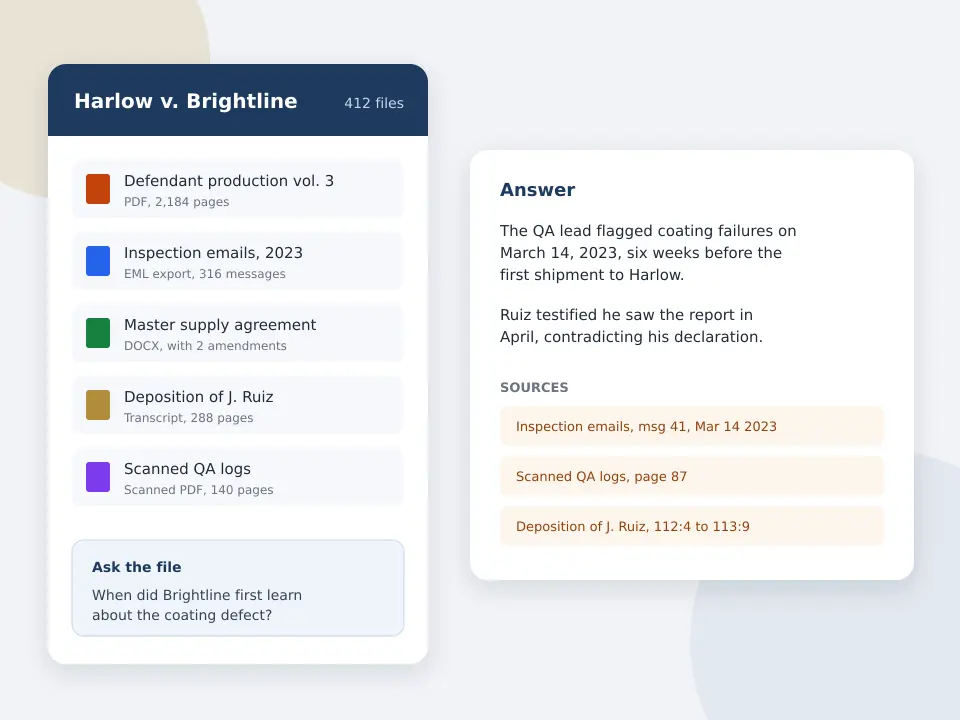
Upload closed matter documents and ask questions with known answers. Every answer names its source document. After signup, try 25 pages across up to 5 files, no card.
Free preview, no account needed: up to 3 files and 10 pages.
What are the best Relativity alternatives for a small law firm?
Everlaw, Logikcull, Nextpoint and GoldFynch are the usual Relativity alternatives for ediscovery, and CaseClerk is the alternative when the job is reading documents rather than producing them, from $99 a month. Relativity prints no price and bills by committed data volume. If you must process, review and produce at volume, stay with an ediscovery platform or a partner running one. If you need sourced answers from a production or client file, compare legal document review software by reading allowance, not by gigabyte.
- No list price
- On Relativity's pricing page, which routes to Request Pricing
- $27
- GoldFynch monthly plan for a 3 GB case, published
- $99
- CaseClerk Solo monthly for 2,500 pages read
- 25 pages
- CaseClerk trial after signup, no card
What to check in any Relativity alternative
- Quote versus published price
- Relativity gives a rate only through Request Pricing or a hosting partner. GoldFynch prints case plans. CaseClerk prints account plans. Ask every vendor for a written total on the same matter size.
- Months of hosting
- Volume billing runs every month a matter stays open. A case that settles early but stays hosted costs the same as one in active review. Ask what happens to charges at closing.
- Partner and services hours
- Many Relativity firms buy through a hosting partner that bills loading and productions by the hour. Ask whether the alternative is self-serve or needs a project manager.
- Processing and productions
- If you must Bates stamp, redact or log privilege, you need a platform that does it. A reading tool does not, so decide which matters need which job.
Compare Relativity alternatives on a closed matter
-
1
Pick a matter you know
Choose a closed case with documents, emails and testimony whose answers you can verify. Write the factual questions and the documents that settle them.
-
2
Separate the two jobs
List what you must do to the documents (process, redact, produce) apart from what you must learn from them. Ediscovery platforms cover the first, a reading tool the second.
-
3
Test the reading
Upload a trial sample to CaseClerk, ask plain-English questions and open the document named in each answer. Include one question the documents cannot answer.
-
4
Price the whole matter
Request written totals for data volume, months hosted and AI use from each ediscovery vendor. Then add CaseClerk only if you need both jobs covered.
Relativity vs CaseClerk by job and billing model
Relativity wins when the assignment is a large review with processing, holds and productions. CaseClerk fits reading a production you received or a client file. The billing units do not measure the same capacity.
| Relativity | CaseClerk | |
|---|---|---|
| Published price | None, Request Pricing | $99, $249, $499 or $998 monthly |
| Billing model | Data volume, pay as you go or 1 or 3 year commitment, per Relativity | Per account by pages read |
| User fees | None on aiR plans, per Relativity | No per user pricing |
| Producing and redacting | Yes | No |
| Getting started | Request pricing, often through a partner | Trial after signup, 25 pages, up to 5 files, no card |
| Answers | Assist and aiR tools over the review workspace | Plain-English questions, source document named in every answer |
| Best fit | Large discovery projects and litigation support teams | Finding facts in documents already available |
Relativity statements come from its pricing page. Confirm current terms before buying. CaseClerk prices cover reading within the stated page allowances.
Where small firms use a reading tool next to Relativity
Reading the other side's production
Ask what received documents say about notice, causation or damages. CaseClerk names the source so you can check the fact before it goes into a motion.
Deposition preparation
Upload testimony, emails and agreements, then ask where a witness's account differs from the written record before you draft questions.
A client file that is not a production
A few hundred documents may hold what you need without a hosted review database. Check the monthly page allowance as well as the file count.
Cutting hosting months
Move the reading to a tool priced by pages, and keep the ediscovery platform or partner only for the weeks you must process and produce.
Relativity competitors and what they print
A missing dollar figure means a quote. This table separates what each vendor states from what is reported elsewhere.
| Tool | How it bills | What it prints | Best for |
|---|---|---|---|
| Relativity | Committed data volume, pay as you go or 1 or 3 year term | No dollar figure; routes to Request Pricing | Large discovery and litigation support |
| Everlaw | Hosted GB plus AI credits | Pricing page requests a demo | Teams that want a full review platform |
| Logikcull | Pay as you go per GB with a 10 GB minimum, annual plans | No figure on its pricing page; its blog announced $40 per GB per month | Self-serve processing and production |
| GoldFynch | Case plans | $27 a month for a 3 GB case, published | The cheapest published small case |
| Nextpoint | Per user, unlimited data | Essential, Advanced and Apex tiers, no prices | Teams that want to avoid per GB billing |
The full Relativity numbers are on our Relativity pricing page. Compare it with DISCO alternatives and Nextpoint pricing before you request quotes.
Relativity or Everlaw for an occasional discovery matter
Both bill by data volume, both can produce and both are sales-led. The difference is in contract terms, partner involvement and AI packaging, which is why a written total on a sample matter beats a feature list. See Everlaw alternatives and Logikcull alternatives for the other billing models.
A Relativity alternative for small firms doing the reading
If most of your spend goes to hosting documents you only need to read, test CaseClerk on a closed matter. Upload, ask, open the cited source, and compare the answer with what you already know. Plans start at $99 a month for 2,500 pages.
Relativity alternatives questions from small law firms
What are the alternatives to Relativity?
How much does Relativity cost?
Is there a cheaper alternative to Relativity for a small case?
Is Relativity too much for a small law firm?
Can I try an alternative without a credit card?

Test the reading job before your next Relativity quote
After signup, try 25 pages across up to 5 files, no card. Ask questions, check the sources and compare plans from $99 monthly.
Start free trialKeep reading
Relativity pricing
Volume billing and reported hosting costs.
DISCO alternatives
Billing models compared for small firms.
Everlaw alternatives
Billing models compared for small litigation firms.
Logikcull alternatives
Per GB billing versus a flat reading price.
GoldFynch pricing
Published case plans and trial limits.
Legal document review software
Compare discovery platforms with tools for document reading.
Choose your plan
Put one matter in a vault and ask it the question you would ask a colleague
Sign up