Ediscovery pricing, checked against Relativity's own page
Relativity Pricing and RelativityOne Pricing with Relativity Cost Per GB
Relativity does not print a price. Its pricing page describes pay as you go and one or three year commitments, then asks you to request pricing. Here is what Relativity confirms, what the reported per GB numbers mean at your matter size, and a published flat price for reading a production.
Relativity figures are labeled with their source. CaseClerk prices are the ones on our pricing page.
Read the production before you host it
Upload one matter's documents and ask what they say. Every answer names the document and page it came from. 25 pages on the house, no card.
Free preview, no account needed: up to 3 files and 10 pages.
How much does Relativity cost?
Relativity does not publish its prices. It charges by data volume, either pay as you go or on a one or three year commitment, and since the September 2026 rename to Relativity aiR it says AI tools are included with the committed volume and there are no per user fees. Third parties report hosting at about $15 to $30 per GB per month, plus $25 to $75 per GB to process native files.
For a 50 GB matter that is roughly $750 to $1,500 a month in hosting alone. If the job is reading documents rather than producing them, CaseClerk does it at a published $99, $249 or $499 a month.
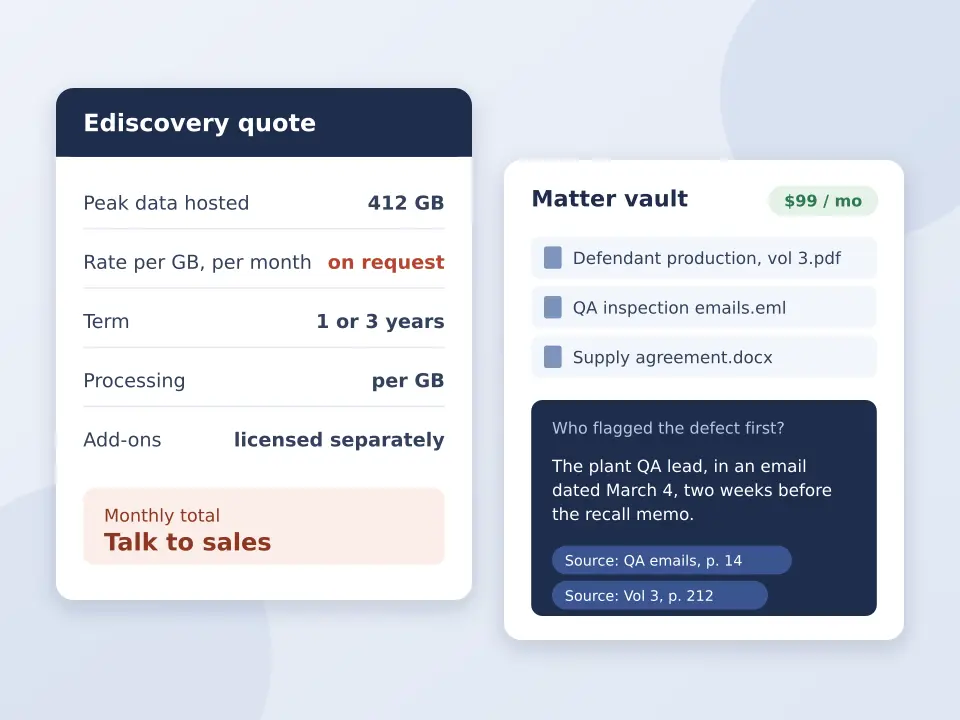
- No list price
- on Relativity's pricing page, which routes to Request Pricing
- $15 to $30
- reported hosting per GB per month, third-party estimate
- Sept 2026
- RelativityOne renamed Relativity aiR, AI included in committed volume
- $99
- CaseClerk Solo, published, per month, no sales call
What sets a Relativity quote
- Committed data volume
- The main line is how many gigabytes you commit to host. Relativity's page says AI tools come with that committed volume, so the volume you sign for drives almost everything else.
- Term length
- Pay as you go is month to month. One and three year commitments lower the rate. Costbench reports discounts of up to 25% on a one year commitment versus pay as you go.
- Processing
- Turning native files into reviewable documents is reported at $25 to $75 per GB. Ask whether processing is inside the plan, as Relativity's aiR page lists it, or billed by your partner.
- Partner services
- Many firms buy through a hosting partner. Project management, loading and productions are billed by the hour on the one partner list we found, from £85 to £210 an hour.
- Separately licensed add-ons
- Data Breach Response, Translate, Relativity FOIA and Legal Hold are licensed apart from the data volume. Only pay for the ones your matters need.
- Archive and reactivation
- Cases go quiet for months. Ask what an archived workspace costs to keep and to bring back, because peak monthly size is what you are billed on.
How to turn a Relativity quote into a number you can compare
-
1
Measure last year's matters
Add up the gigabytes you actually hosted per matter and for how many months. That is the workload you are pricing, not the biggest case you can imagine.
-
2
Ask for one all-in monthly figure
Hosting, processing, add-ons and partner hours in one number, in writing, for the term you would sign, on the current aiR plans.
-
3
Split reading from producing
Mark which matters needed a production with Bates numbers and a privilege log, and which only needed someone to read the documents. Only the first kind needs an ediscovery platform.
-
4
Run a reading matter through a flat priced tool
Upload a closed matter's documents to CaseClerk and ask the questions your team answered by hand. If that covers the job, you have a second number to hold against the quote.
Relativity, Everlaw, Logikcull and CaseClerk compared by job and price
Relativity, Everlaw and Logikcull run discovery: processing, coding and production. CaseClerk reads documents and answers questions about them. Pick by the job you are paying for.
| Relativity aiR | Everlaw | Logikcull | CaseClerk | |
|---|---|---|---|---|
| Price visibility | Quote only, Request Pricing | Quote only | No figure on its pricing page; its blog published $40 per GB per month, with a 10 GB minimum on pay as you go | Published: $99, $249, $499 a month, plus a quoted Enterprise tier |
| Billing model | Data volume, pay as you go or 1 or 3 year commitment | Reported monthly fee per GB hosted | Per GB of data each month, or annual subscription | Flat account price with a monthly page allowance |
| User fees | None on aiR plans, per Relativity | Unlimited user licenses, per Everlaw | Unlimited users, per Logikcull | No per user pricing |
| Processing and productions | Yes | Yes | Yes | No. It reads files you upload and does not produce |
| Privilege logs and redaction | Yes | Yes | Yes | No |
| Cited answers across a matter | Yes, through Assist and aiR tools | AI features billed in credits | Reveal AI fact-finding on the annual plan | Yes, every answer names the document and page |
| Best for | Large discovery projects and litigation support teams | Cloud ediscovery for litigation teams | Small and mid-size teams that want self-serve discovery | Small firms that need to read a production or client file at a fixed cost |
Who should pay for Relativity, and who should not
Buy Relativity to run discovery
If you collect from custodians, code for responsiveness, log privilege and produce with Bates numbers, Relativity or a partner running it is built for that work, and the per GB quote buys the whole workflow.
Think again for reading a received production
Hosting the other side's production at $15 to $30 per GB every month to find what it says about three issues is an expensive way to read. You need answers, not a review workspace.
Use CaseClerk for the reading
Upload the production, the client's emails and the key contracts for one matter, and ask who knew what and when. Each answer names the document and page, so you check it in seconds.
Keep your ediscovery vendor for productions
CaseClerk does not process ESI, Bates stamp or build privilege logs. Firms that produce keep a platform or partner for that and use CaseClerk for the questions the case turns on.
Why every Relativity price you read is different
The pages that rank for Relativity pricing quote numbers that measure different things, and none of them comes from Relativity. Some are hosting rates, some are per user fees from the older RelativityOne model, and one is a median that cannot be squared with the range printed next to it.
| What is reported | Figure | Where it comes from |
|---|---|---|
| Cloud hosting per GB | $15 to $30 per GB per month, lower with bigger volume commitments | AI Vortex estimate. Relativity has not confirmed it |
| Processing per GB | $25 to $75 per GB to ingest and process native files | AI Vortex estimate |
| Review user licenses | $75 to $150 per user per month | AI Vortex estimate, written for the older RelativityOne model. Relativity now says its aiR plans carry no per user fees |
| Monthly range | $500 to $25,000 a month | Costbench, which labels all pricing custom |
| Median customer | $800 a year from 61 purchases | Costbench. This cannot sit inside a $500 to $25,000 monthly range, so treat both with care |
| Partner list price | £75 per user per month, £5 per GB per month hosting, £5 per GB self service processing, month to month | A Relativity hosting partner's UK G-Cloud 14 price list (May 2024), the only printed rate card we found |
| Typical hosting benchmark | $30 per GB per month, so $3,000 a month for a 100 GB matter | Logikcull's own blog, describing a typical hosted platform |
The pattern is the same one we found for Everlaw pricing. The vendor prices by data volume through sales, so the public numbers are estimates collected from buyers and partners. Use them to sanity check a quote, not to budget a matter.
RelativityOne is now Relativity aiR, and the pricing changed with it
In September 2026 Relativity renamed RelativityOne as Relativity aiR. The pricing page moved with the name. It now says the AI tools (Assist, aiR Review, aiR for Privilege and Case Strategy, with the claiR assistant listed as coming soon) come standard with your committed data volume, with no separate AI licenses and no per user fees. Processing, analytics, redaction, the native viewer and AV transcription are listed as part of every plan.
Two things are still billed apart. Data Breach Response, Translate, Relativity FOIA and Legal Hold are licensed separately, and the committed data volume itself is quoted. The step before the rename came in October 2025, when Relativity announced all-inclusive per GB pricing for aiR for Review and aiR for Privilege from November 1, 2025, replacing per document charges.
The practical point: most estimates in circulation, including the per user license figures above, describe a model Relativity has since replaced. Ask any quote to be written against the current aiR plans.
Relativity cost per GB at three matter sizes
Here is what the reported hosting rates mean for a firm hosting one matter. These are hosting charges only, using the $15 to $30 per GB per month range that third parties report. They are not Relativity's numbers.
| Hosted data | At $15 per GB | At $30 per GB | What usually comes on top |
|---|---|---|---|
| 50 GB (one mid-size matter) | $750 a month | $1,500 a month | Processing at $25 to $75 per GB once, project management hours |
| 200 GB | $3,000 a month | $6,000 a month | Same, plus any separately licensed add-on |
| 500 GB | $7,500 a month | $15,000 a month | Partner services, which AI Vortex puts at $5,000 to $25,000 to set up |
Hosting is charged on the data in the workspace, and the UK partner list bills on the peak size each month, including indexes and productions, not only the native files you uploaded. A 50 GB collection can sit larger once it is processed and produced. Ask how the vendor measures billable size before you compare per GB figures.
Relativity license cost if you buy through a partner
Many firms never sign with Relativity directly. They use a hosting partner or litigation support vendor that resells the platform and adds project management. The one printed rate card we found is a partner's UK government list: £75 per named user per month, £5 per GB per month hosting, £5 per GB for do it yourself processing and £185 per GB for full service processing, month to month with no minimum, and early case assessment workspaces free for 90 days.
US partner pricing differs and is quoted, but the structure is useful. Expect a hosting line, a processing line, project management by the hour and possibly user fees, depending on whether the partner's contract with Relativity is on the newer aiR terms.
Is Relativity worth it for a small firm?
Relativity is worth it when you have to run discovery, not just read it: processing custodian data, coding documents for responsiveness, building a privilege log and producing with Bates numbers to the other side. It is a standard platform for that, and courts and opposing counsel know its outputs.
It is harder to justify when the job is reading a production you received, or the client's own documents, to find out what they say. Paying per GB per month to host a few thousand pages for the life of a case is a large bill for a question an associate could answer in a day with the right tool. That reading job is what CaseClerk prices flat.
Where a flat priced reading tool is enough
CaseClerk is a document reading tool, not an ediscovery platform. You upload one matter's files into a vault, up to 1,000 files in 18 formats including scanned PDFs and email, and ask questions in plain English. Each answer names the document, and the page where the file has pages, so you can check it before it goes into a memo.
Plans are published: Solo $99 a month for 2,500 pages, Professional $249 for 10,000 pages and Firm $499 for 30,000 pages, with a quoted Enterprise tier above that. A year costs six months. There is no per GB hosting meter. For the full comparison of review platforms and analysis tools by job, see our page on legal document review software for small firms.
What to ask before you sign a Relativity quote
- Is the quote on the current Relativity aiR plans, with AI included in the committed volume, or on older RelativityOne terms?
- How is billable data measured: native size, processed size or peak workspace size including productions?
- What is the per GB rate for pay as you go, and for a one year and a three year commitment?
- Which add-ons are in the price, and which (Translate, Legal Hold, Data Breach Response) are separate?
- If you buy through a partner, what are the project management rates and minimums?
- What does it cost to archive the workspace when the case goes quiet, and to bring it back?
Then hold the quote against your real workload. If most of the matter is reading and not producing, price that part separately.
Relativity pricing questions firms ask
How much does Relativity cost?
Relativity does not publish prices. It charges by data volume, pay as you go or on one or three year commitments, and its aiR plans include the AI tools and carry no per user fees, according to its pricing page. Third parties report hosting at about $15 to $30 per GB per month plus $25 to $75 per GB for processing. Relativity has not confirmed those figures.
How much does RelativityOne cost per GB?
Reported RelativityOne hosting runs about $15 to $30 per GB per month, with the lower end for large volume commitments. The only printed rate card we found, a partner's UK government list, shows £5 per GB per month for hosting. Ask how billable size is measured, because the partner list bills peak workspace size including indexes and productions.
Is RelativityOne now called Relativity aiR?
Yes. Relativity renamed RelativityOne as Relativity aiR in September 2026. The pricing page now says AI capabilities such as aiR Review, aiR for Privilege and Case Strategy come with your committed data volume, without separate AI licenses. Older articles quoting RelativityOne prices describe the previous packaging.
Does Relativity charge per user?
Not on the current aiR plans, according to Relativity's pricing page, which says the AI capabilities come with no per user fees. Older estimates of $75 to $150 per review user per month describe the earlier model, and some hosting partners still list user licenses, so check the contract you are actually offered.
How much does Relativity aiR for Review cost?
Relativity announced all-inclusive, unlimited per GB pricing for aiR for Review and aiR for Privilege from November 1, 2025, and since the 2026 rename it says those tools are included with your committed data volume. No per GB figure is published, so the cost sits inside your hosting quote.
What is a cheaper alternative to Relativity for a small firm?
If you need to produce documents, self-serve platforms such as Logikcull bill per GB with no user fees and a 10 GB minimum on pay as you go. If you only need to read a production or client file and find answers, CaseClerk does that at a published $99, $249 or $499 a month, with every answer citing its source page.
Does Relativity have a free trial?
Relativity's pricing page does not offer a self-serve trial. The route in is Request Pricing or a partner. Some partners offer free early case assessment workspaces for a limited time; the UK partner list we found gives 90 days. CaseClerk's trial is 25 pages, up to 5 files, with no card.

Read the documents before you buy the platform
Upload one matter's files, ask the questions the case turns on, and check every cited page. 25 pages, no card, published prices from $99 a month.
Start free trialKeep reading
Legal document review software
Ediscovery platforms and document analysis tools compared by job and price for small firms.
Everlaw pricing
What Everlaw is reported to cost at 10, 50 and 200 GB, and what its own pages say.
Logikcull pricing
Logikcull's pay as you go per GB model, its 10 GB minimum and what a year really costs.
AI due diligence software
Reading a deal data room at a published price, every answer sourced.
CoCounsel pricing
Thomson Reuters prints no price either. Reported figures and a flat option.
CaseClerk pricing
Three published tiers with page allowances printed next to each. A year costs six months.
Choose your plan
Put one matter in a vault and ask it the question you would ask a colleague
Sign up