For small litigation firms reviewing an Everlaw quote
Everlaw Alternatives and Everlaw Competitors for Small Law Firms
Compare your Everlaw quote or renewal against the work your firm does. Producing discovery and reading an incoming production can call for different tools. Here are the alternatives, published prices and questions that make quotes comparable.
Vendor prices are attributed. Third-party estimates and older blog rates are labeled separately from current quotes.
Test the reading job on your own documents
Upload closed matter documents and ask questions with known answers. Every answer names its source document. After signup, try 25 pages across up to 5 files, no card.
Free preview, no account needed: up to 3 files and 10 pages.
Which Everlaw alternatives fit a small law firm?
Logikcull, GoldFynch, Nextpoint, DISCO and Relativity are Everlaw alternatives for ediscovery, while CaseClerk handles document reading from $99 a month. GoldFynch has the cheapest published option for small discovery cases among these choices, and Logikcull offers pay as you go without a commitment. If you need processing, review, redaction, privilege logs and production, keep an ediscovery platform; if you need sourced answers from documents already received, compare legal document review software by its reading allowance.
- 10 GB
- Pay as you go minimum on Logikcull's pricing page
- $27
- Monthly 3 GB case plan published by GoldFynch
- $99
- CaseClerk Solo monthly for 2,500 pages read
- 25 pages
- CaseClerk trial after signup, no card
What to check in any Everlaw alternative
- The billing unit
- Everlaw describes hosted GB billing, Nextpoint prices per user, and CaseClerk prices accounts by pages read. Compare the same workload and term before deciding which headline rate is cheaper.
- Every month of hosting
- Budget every month a matter stays hosted, including quiet periods. Ask how charges change when a case closes, data is removed or the workspace must remain available.
- AI credits and scope
- Everlaw lists Deep Dive, machine translation and custom extractions as credit features. Ask what your expected questions consume and whether a proposed alternative includes the AI functions you need.
- Minimums and commitments
- Logikcull's pricing page states a 10 GB monthly minimum. Compare minimum charges with annual commitments, and request the total payable if your workload shrinks.
- The production workflow
- Decide whether you need review coding, privilege logs, redactions and productions. CaseClerk does not supply these workflows, Bates numbering or legal holds, and does not process PST collections at scale.
- A useful trial
- Logikcull supplies a sample matter but requires a card for uploads. Nextpoint offers a demo instead of a trial. CaseClerk lets you check sourced answers on your own trial documents.
Compare Everlaw alternatives on a closed matter
-
1
Choose a case with known answers
Use a closed matter with production documents, emails and testimony you know. Write down factual questions and the documents establishing the answers before testing.
-
2
Test the work you need
For reading, upload a trial sample to CaseClerk and ask plain-English questions. For discovery, ask the platform vendor to demonstrate your required review and production workflow on representative material.
-
3
Check the source documents
Open the document named in each CaseClerk answer and check the statement against the record. Include a question the documents cannot answer to assess how useful the response is.
-
4
Price the complete matter
Request costs for expected data, hosting months, AI use and commitment. Compare CaseClerk against reading within its page allowance, then decide whether you also need a discovery platform.
Everlaw vs CaseClerk by job and billing model
Everlaw wins when the assignment is running discovery. CaseClerk fits reading a received production or client file. Their billing units do not measure equivalent capacity.
| Everlaw | CaseClerk | |
|---|---|---|
| Published price | No dollar figure on its pricing page | $99, $249, $499 or $998 monthly |
| Billing model | Monthly hosted GB per its blog, plus AI credits | Per account by pages read, no GB billing |
| User charges | Unlimited user licenses per Everlaw | No per user pricing |
| AI questions | Deep Dive billed in credits per Everlaw | Plain-English questions with a source document named in every answer |
| Large PST collections | Ediscovery platform for processing and review | No processing of PST collections at scale |
| Review coding and privilege logs | Ediscovery workflow | Neither is provided |
| Redaction and production | Ediscovery workflow, no production fees per its older blog | No redaction, Bates numbering or productions |
| Getting started | Pricing page ends in Request a Demo | Trial after signup, 25 pages, up to 5 files, no card |
| Best fit | Processing, reviewing and producing discovery | Finding facts in documents already available |
Everlaw billing descriptions come from its pricing page and its 2016 and 2017 blog posts. Confirm current contract terms. CaseClerk prices cover reading within the stated page allowances.
Where small firms use a document reading tool
Reading the other side's production
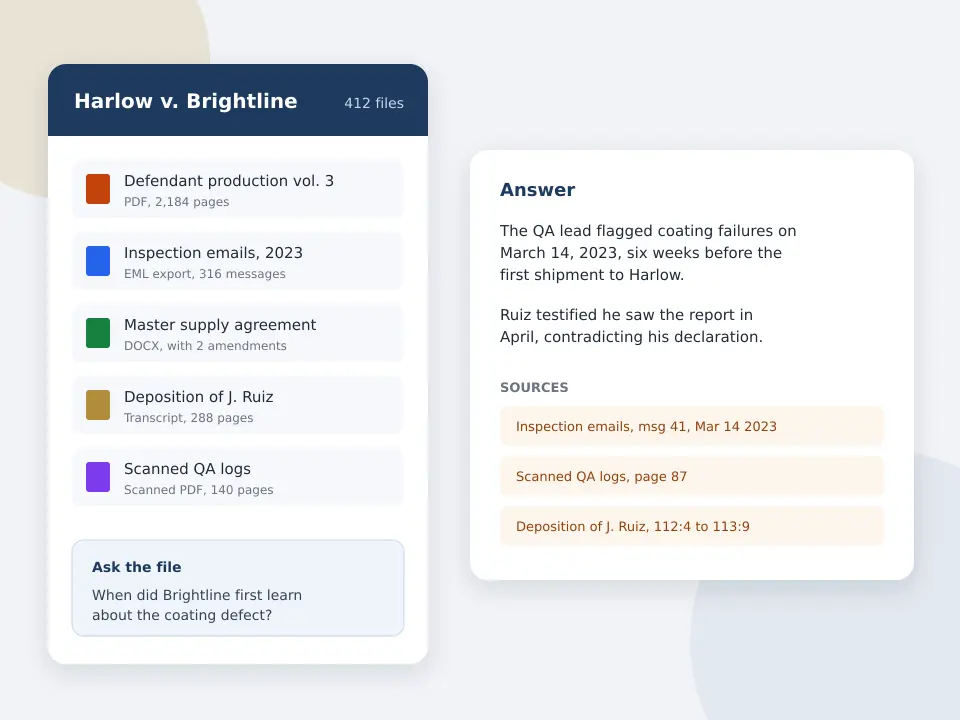
Ask what the received documents say about notice, causation or damages. CaseClerk names the source document so you can check the fact before using it in a motion.
Preparing for a deposition
Upload testimony, emails and relevant agreements. Ask where a witness's account differs from the written record, then read the named documents before drafting questions.
Understanding a client file
A few hundred to 1,000 documents can contain the facts you need without requiring a production workflow. Check the monthly page allowance as well as the file count.
Keeping discovery and reading separate
Keep an ediscovery platform for processing, privilege work and production. Test CaseClerk on the reading questions from that matter, and include both costs if you need both tools.
Everlaw competitors and the prices they publish
A missing dollar figure requires a quote. This table distinguishes vendor statements from reported rates.
| Tool | How it bills | What it prints | Best for |
|---|---|---|---|
| Everlaw | Monthly per GB hosted, per its own blog; AI credits | Pricing page prints no dollars and requests a demo. AI Vortex (2026) reports $18 to $35 per GB, not a vendor quote. | Firms running discovery rather than only reading documents |
| Logikcull, part of Reveal | Monthly per GB stored or annual subscription | Pricing page prints no dollars. It states a 10 GB pay as you go minimum and no commitment. Its blog announced $40 per GB per month. | Occasional discovery without an annual commitment |
| GoldFynch | Monthly per case by GB | Vendor lists $27 for 3 GB, $76 for 10 GB, $342 for 50 GB and $652 for 100 GB. Unlimited users and free OCR. | Small discovery cases needing a published budget |
| Nextpoint | Flat per user with unlimited data | Vendor prints no dollars. Essential, Advanced and custom Apex plans have no hosting, OCR or production fees. Annual upfront payment is discounted. | Firms preferring user costs to data hosting costs |
| DISCO | One per GB price on processed data | Vendor prints no rate. Sales quotes include ediscovery, Cecilia AI, deposition management and timelines, with no ingest fees or seat charge. | Firms seeking those tools within one data rate |
| RelativityOne / Relativity aiR | Data volume, pay as you go or commitment | Vendor prints no price and states no per user fees. Third parties report $15 to $30 per GB monthly hosting plus $25 to $75 per GB processing. | Firms evaluating another discovery platform by quote |
| CaseClerk | Per account by pages read | $99, $249, $499 or $998 monthly with published page allowances | Reading received productions and client files with sourced answers |
GoldFynch also publishes a flat $200 monthly Organizations charge, and non-US hosting costs about 50% more. Above 300 GB, each extra 50 GB costs $275 monthly per GoldFynch. Its free trial case is 512 MB for 90 days with watermarked productions. See GoldFynch pricing before sizing a case. Relativity describes commitments of 1 to 3 years alongside pay as you go.
What a 50 GB matter costs over six months
This illustration holds the data volume and term constant for the hosting platforms. The Everlaw example uses $25 per GB within AI Vortex's reported $18 to $35 range. It is not a published Everlaw rate. The Logikcull example uses its own blog announcement.
| Option | Six month calculation | Total | What that covers |
|---|---|---|---|
| Everlaw hosting illustration | 50 GB x $25 x 6 | About $7,500 | Hosting only at an illustrative rate within AI Vortex's reported range, not an Everlaw quote |
| Logikcull blog rate illustration | 50 GB x $40 x 6 | $12,000 | Uses the rate Logikcull announced on its blog, not a current sales quote |
| GoldFynch published case plan | $342 x 6 | $2,052 | The vendor's 50 GB monthly case plan |
| CaseClerk Professional | $249 x 6 | $1,494 | Reading up to 10,000 pages a month, no production workflow |
These totals buy different work. Pages and GB are different units, and the relationship varies widely by file type. CaseClerk Professional does not promise to read a 50 GB collection or produce it. Its allowance is 10,000 pages read per month. Use actual page counts to judge fit, and get an Everlaw quote including AI credits before treating the hosting example as a budget.
Everlaw vs Logikcull for an occasional discovery matter
Everlaw vs Logikcull is a quote comparison, not proof that Logikcull is cheaper. Neither pricing page prints a dollar rate. Everlaw's 2016 and 2017 blog posts describe monthly hosted GB fees without user, processing or production fees, with pay as you go or a lower rate for annual volume commitments. Its pricing page now lists AI credits and an intake and case management add-on.
Logikcull, now part of Reveal, lists monthly pay as you go with unlimited users, projects and downloads. Its annual Subscription adds Reveal AI fact finding, AV transcription and PII redaction. Corporate Suite adds legal holds and collection from 31 or more sources, according to Logikcull. Price the tier you need, then compare the same data and hosting term. Our Everlaw pricing breakdown and Logikcull pricing breakdown explain the source distinctions.
An Everlaw alternative for small law firms doing the reading
CaseClerk Solo is $99 monthly for 2,500 pages, Professional $249 for 10,000, Firm $499 for 30,000 and Enterprise $998 for 60,000. Annual billing costs six months' price. Each plan bills the account by pages read, not users or GB.
Upload a matter's documents, ask plain-English questions and check the source document named in every answer. CaseClerk supports 20 formats, including PDF, Word, EML and MSG email, TIFF, JPG and PNG scans, and spreadsheets, with up to 1,000 files per case. Check the pages you need against the allowance.
Everlaw alternatives questions from small law firms
What are the alternatives to Everlaw?
Who are Everlaw's competitors?
Is Logikcull cheaper than Everlaw?
Is there a cheaper alternative to Everlaw for small firms?
Does Everlaw charge per user?
Can CaseClerk replace Everlaw?
How should I compare ediscovery software for small law firms pricing?

Test the reading job before renewing Everlaw
After signup, try 25 pages across up to 5 files, no card. Ask questions, check the sources and compare plans from $99 monthly.
Start free trialKeep reading
Everlaw pricing
Published billing terms, reported hosting rates and AI credits.
Logikcull pricing
The blog rate, pricing page minimum and annual plan differences.
GoldFynch pricing
Published case plans, trial limits and additional charges.
DISCO pricing
The quoted per GB model and what DISCO includes.
Relativity pricing
Volume billing and reported hosting and processing costs.
Legal document review software
Compare discovery platforms with tools for document reading.
Choose your plan
Put one matter in a vault and ask it the question you would ask a colleague
Sign up