For family law attorneys whose hours go into disclosures and statements
AI for Family Law Attorneys Reading Financial Records
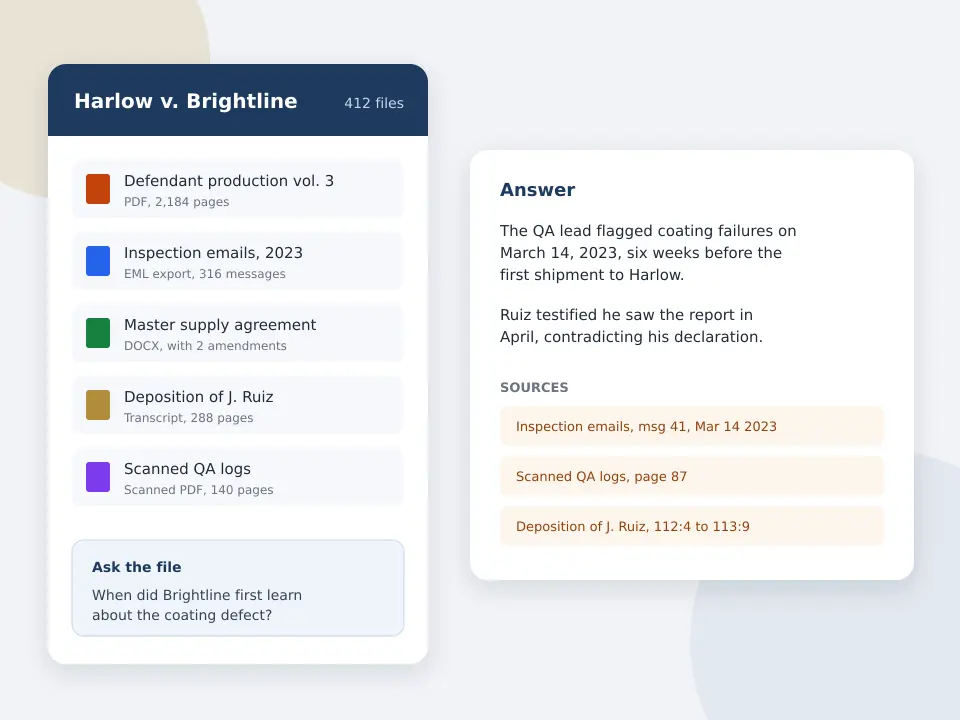
CaseClerk is AI for family law attorneys who need a divorce or custody file read before the hearing. Upload bank and credit card statements, tax returns, financial affidavits, discovery responses, school and medical records and message exports, ask a question in plain English, and get the answer with the document and page behind it. Solo is a flat $99 a month for 2,500 pages.
CaseClerk reads the documents you upload and cites the page. It does not trace funds, value a business, calculate support or give legal advice. A lawyer opens and checks every cited page.
Try it on a file you already know
Upload a closed divorce or custody file and ask questions whose answers you know. Open each cited page and check. After signup, try 25 pages across up to 5 files, no card.
Free preview, no account needed: up to 3 files and 10 pages.
How can AI help a family law attorney with a divorce file?
AI helps a family law attorney by reading every statement, return and disclosure in the file and answering the questions that decide the hearing, each with the page it came from. Which accounts appear in the bank records but not on the financial affidavit, when income changed, what each party said about the children's schedule. CaseClerk does this from $99 a month for 2,500 pages.
It reads. You decide. Every answer is a pointer to a page you open and verify before it goes into a motion, a mediation statement or a cross examination outline.
- $99
- Solo monthly plan, 2,500 pages read
- About $29
- To read a worked 720 page disclosure set on Solo
- Page cites
- Every answer names the document and page
- 5 files
- Trial after signup, 25 pages, no card
What AI for family law has to do with a real file
- Compare the affidavit to the statements
- Upload the financial affidavit and twelve months of statements. Ask which accounts, transfers or recurring deposits appear in the statements and are missing from the affidavit.
- Read the other side's production
- Opposing discovery responses arrive as a few hundred scanned pages. Ask what was produced for each request and which requests have no matching document.
- Build a dated timeline
- Separation date, account openings, large transfers, relocations and missed exchanges, ordered by date and linked to the page that states each one.
- Keep custody records together
- School attendance, medical visits, counselor notes and message exports in one matter. Ask who handled pickups in a given semester and open the pages that say so.
- Find what was said
- Upload exported text and email threads. Ask where a party mentioned a purchase, a move or a promise, and read the message in its thread.
- One vault per client
- Each client matter is its own vault, so two files that share a party or a child never mix.
How a divorce file review works in CaseClerk
-
1
Create a matter for the client
One vault per case keeps the documents apart from every other file.
-
2
Upload what you have
Statements, returns, affidavits, discovery responses, records and message exports. Scans are fine.
-
3
Ask the questions you would ask a paralegal
Which deposits are not on the affidavit, when did the balance drop, what did the other side produce for request 14.
-
4
Open every cite
Read the passage in context and quote from the original page, never from the answer alone.
Ways a family law firm gets through the financial file
Most firms combine several. A paralegal reads and tabulates, a forensic accountant handles tracing and valuation, practice management stores the file, and a cited reader answers questions about it. CaseClerk is the reader and it is priced flat. The others win at their own jobs.
| Paralegal reading | Forensic accountant | Practice management | CaseClerk | |
|---|---|---|---|---|
| Main job | Read and tabulate by hand | Trace funds, value assets | Store, track and bill | Answer questions about the file |
| Cites the source page | Only if the notes do | In the report | Not its job | Yes, document and page |
| New question on the same file | Another read | Another engagement | Search | Ask again, same file |
| Price model | Salary or hourly time | Hourly or fixed fee | Per user per month | Flat monthly, $99 to $998 |
| Best for | Judgment and client contact | Complex assets and expert testimony | Running the practice | Fast, cheap first read of every file |
| Where it wins | Context a tool cannot see | Opinions a court will accept | Deadlines and billing | Price and cited answers |
Where family law attorneys use it
Before the first conference
Read the client's own box of statements and returns and know what the file shows before you quote a position.
After discovery responses arrive
Match what was produced to what was requested and list the gaps for a deficiency letter.
Before mediation
Pull the dated facts on income, spending and parenting time into one outline, each with a page you can hand to the mediator.
Post-judgment modification
Years later, the old decree, the old disclosures and new income records sit in one vault and answer one question.
Why the financial file is where a family law matter loses hours
A divorce file grows by paper. The client brings a box of statements, the other side produces more after a request, and each set has to be read against the financial affidavit and against each other. That reading is rarely billable at a rate the client will absorb, and it repeats every time a new account turns up.
A cited reader takes the first pass. If you want the same approach applied to a dated narrative, the pages on case chronology software and document comparison software for lawyers show the output in detail. For a general view of what a reader costs against per seat suites, see AI for small law firms.
A worked example, a 720 page disclosure set
Say a contested divorce file holds 24 months of statements for six accounts (about 480 pages), two years of returns (110 pages), the client's affidavit (30 pages) and the other side's discovery responses (100 pages). That is 720 pages. On Solo, 2,500 pages cost $99 a month, so reading 720 pages uses about 29 percent of the month, roughly $29.
A paralegal who tabulates the same set by hand might spend a full day or more. That is an assumption, not a measurement, and your own numbers will differ. The point is the shape of the cost: the reader runs once per file, and later questions reuse the file.
What it does not do
CaseClerk does not trace commingled funds, classify property as marital or separate, value a practice or calculate support. Those are legal and accounting judgments. It finds the passages that bear on them and shows you where they are.
Privilege and confidentiality still apply to what you upload. The American Bar Association's Formal Opinion 512 covers a lawyer's duties when using generative AI tools, including competence, confidentiality and verification.
Who it is for and who it is not for
It is for solo and small firm family lawyers who do their own reading, or who pay a paralegal to, and want a cheap cited first pass on every file. It is not for firms that need a forensic accounting opinion, a drafting tool or a document assembly engine for pleadings. Those are different products.
AI for family law attorneys, questions from practitioners
Can AI review a divorce file?
Can AI find hidden assets in bank statements?
What does AI for family law cost?
Is it safe to upload client financial records?
Does CaseClerk draft pleadings or calculate support?
Can it read scanned and exported messages?

Read your next disclosure set with cited answers
After signup, try 25 pages across up to 5 files, no card. Ask about accounts, income changes and gaps, then open every source. Plans from $99 monthly.
Start free trialKeep reading
Case chronology software
A dated chronology with page cites.
Document comparison software
Where two accounts disagree.
AI paralegal
A flat priced reader for paralegal hours.
AI for small law firms
What a flat reader costs against per seat suites.
Legal document review software
Read a production with cited answers.
Choose your plan
Put one matter in a vault and ask it the question you would ask a colleague
Sign up