Case management pricing, checked against Filevine's own page
Filevine Pricing and Filevine Cost Per User with Filevine AI Pricing
Filevine does not print a price. Its pricing page lists LOIS, Matters, Intake, Depositions and Signatures and says every package is custom built. Here is what third parties report, what it means at your firm size, and a published flat price if what you need is AI that reads case files.
Filevine figures are labeled with their source. CaseClerk prices are the ones on our pricing page.
Read the medical records before you buy a platform
Upload one matter's records and ask what they say. Every answer names the document and page it came from. 25 pages on the house, no card.
Free preview, no account needed: up to 3 files and 10 pages.
How much does Filevine cost?
Filevine does not publish its pricing. It sells custom packages per user, with modules such as Intake, Depositions, Signatures and its LOIS AI quoted on top. Third parties report $49 to $87 per user per month at entry, $100 to $150 with AI and the full suite, and $5,000 to $25,000 to implement.
For a ten user plaintiff firm that is roughly $12,000 to $18,000 a year in licenses before setup. If the job you want AI for is reading records and case files, CaseClerk does that at a published $99, $249 or $499 a month next to the case management you already run.
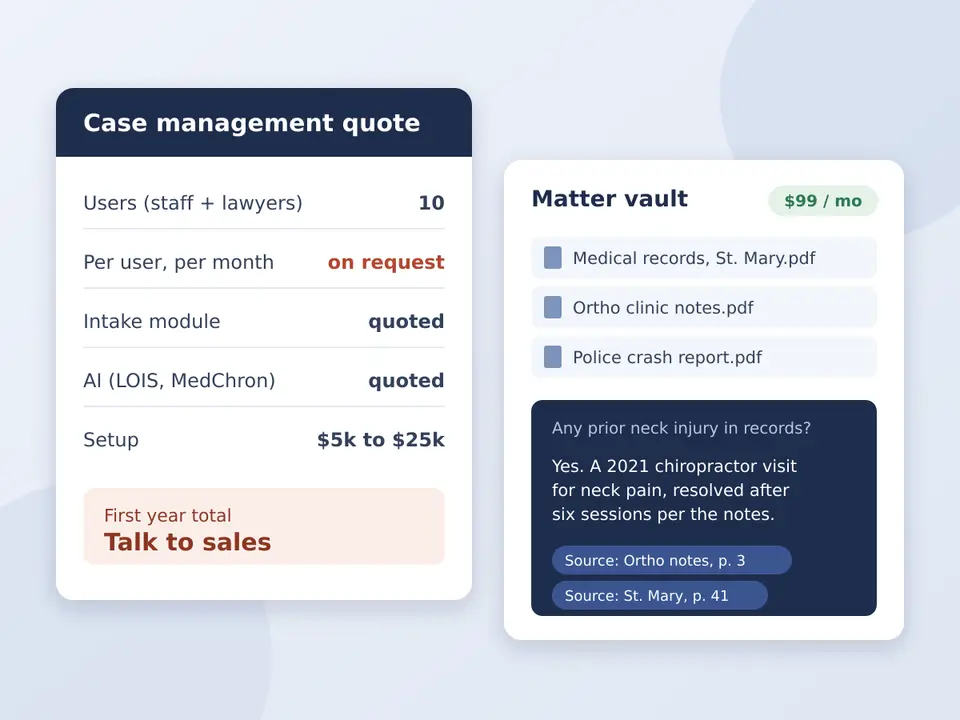
- No list price
- on Filevine's pricing page, every package is custom built
- $49 to $150
- reported cost per user per month, third-party estimates
- $5k to $25k
- reported implementation cost, third-party estimate
- $99
- CaseClerk Solo, published, per month, no sales call
What sets a Filevine quote
- Seats by role
- Filevine bills the core platform per user per month. Lawyers, paralegals, case managers and intake staff all count, so a small firm's seat total is usually larger than its lawyer count.
- Modules
- Matters, Intake, Depositions and Signatures are separate packages on Filevine's pricing page. Lead Docket intake alone is reported at about $150 per user per month.
- LOIS AI
- Ask LOIS, AI Drafting, Depo Copilot, Depo Summaries and MedChron are listed under LOIS and quoted. Only LOIS Explore, without case management, is free.
- Implementation
- Migration and setup are reported at $5,000 to $25,000 and four to eight weeks, depending on how many matters and documents you move.
- Integrations
- Accounting and other integrations can carry their own fee. One user reported $4,000 a year for the QuickBooks integration alone.
- Term
- Contracts are custom. Ask for the renewal cap, the term length and the data export terms before you sign, not at renewal.
How to turn a Filevine quote into a number you can compare
-
1
List every seat by role
Write down who logs in each day and who only views. That headcount, not your number of lawyers, drives the license line.
-
2
Ask for one all-in figure
Licenses, modules, AI, integrations and implementation in one first year number and one renewal year number, in writing.
-
3
Split case management from AI
Mark which part of the quote you need to run the practice and which part you want for AI over records. They can come from different vendors.
-
4
Test the reading job on a closed case
Upload a settled matter's records to CaseClerk and ask the questions your paralegals answered by hand. If it covers the job, you have a second number to hold against the AI line.
Filevine, EvenUp, Supio and CaseClerk compared by job and price
Filevine runs the practice. EvenUp and Supio produce demand packages and chronologies for plaintiff firms. CaseClerk reads a matter's documents and answers questions about them. Pick by the job you are paying for.
| Filevine | EvenUp | Supio | CaseClerk | |
|---|---|---|---|---|
| Price visibility | Quote only, custom packages | Quote only | Quote only | Published: $99, $249, $499 a month, plus a quoted Enterprise tier |
| Billing model | Per user per month plus modules | One cost per case for the whole platform, since December 2025 | Per case, scaled by volume, per its LawNext listing | Flat account price with a monthly page allowance |
| Case management | Yes, the core product | No | No | No |
| Demand letters | DemandsAI, quoted | Yes, the core product | Yes | No |
| Cited answers across a case file | Ask LOIS, quoted | Within its case workflow | Within its case workflow | Yes, every answer names the document and page |
| Implementation | Reported $5,000 to $25,000 | Onboarding by sales | Onboarding by sales | None. Upload files and ask |
| Best for | PI firms that need one system to run every matter | PI firms buying finished demands at volume | PI firms that want AI case analysis across a caseload | Firms that need records read and checked at a fixed cost |
Who should pay for Filevine, and who should not
Buy Filevine to run the practice
If you need intake, deadlines, task workflows, client texting and settlement tracking in one place, Filevine is built for plaintiff firms and the per user price buys that whole system.
Think again if AI is the only reason
Moving every matter to a new case management platform to get AI over medical records is a large project for a reading problem, and the AI is quoted on top anyway.
Use CaseClerk for the reading
Upload one matter's records, bills and transcripts and ask about treatment dates, prior injuries and gaps in care. Each answer names the page, so a paralegal checks it fast.
Keep your case management
CaseClerk does not replace Clio, MyCase, CASEpeer or Filevine. Firms keep their system of record and use CaseClerk where the hours go, reading the file.
Why every Filevine price you read is different
Search for Filevine pricing and you get a different number on every page: $49, $65, $87, $150, $250. They are not all wrong. They describe different bundles. Filevine sells a core case management license per user, then stacks modules on top (intake, depositions, signatures, document automation, its LOIS AI tools), and each one can change the bill. None of the figures below comes from Filevine.
| What is reported | Figure | Where it comes from |
|---|---|---|
| Entry price per user | $49 to $87 per user per month | Software aggregators and community reports, as summarized by ProPlaintiff. Filevine has not confirmed either end |
| Core platform tier | $50 to $75 per user per month | AI Vortex estimate, no named source |
| With document automation | $75 to $100 per user per month | AI Vortex estimate |
| Full suite with AI | $100 to $150 per user per month | AI Vortex estimate, including MedChron and Lead Docket |
| Fully configured firm | $125 to $250 per user per month | User reports quoted by review roundups |
| Three attorney firm with add-ons | About $150 per user per month for three licenses | One user account, reported by ProPlaintiff |
| Single user setup | About $2,500 a year | One user account, reported by ProPlaintiff |
| Lead Docket intake | About $150 per user per month on top of core licenses | User report, ProPlaintiff |
| QuickBooks integration | $4,000 a year as a separate line | One user report, ProPlaintiff |
| Implementation | $5,000 to $25,000, four to eight weeks | AI Vortex estimate. One user reported paying a third party implementer $1,500 |
Read the table as a range of bundles, not a price list. The low end is a bare case management seat. The top end is a configured plaintiff firm with intake, automation, AI and integrations. Your quote will sit wherever your module list puts it.
Filevine cost per user at three firm sizes
Here is what the reported per user rates mean in a year. The first three columns are license cost only. The last column adds the reported $5,000 to $25,000 implementation range to the low and high license figure, because the first year is the one you budget.
| Firm size | At $50 per user | At $100 per user | At $150 per user | Year one with implementation |
|---|---|---|---|---|
| 3 users (solo plus two staff) | $1,800 a year | $3,600 a year | $5,400 a year | $6,800 to $30,400 |
| 10 users | $6,000 a year | $12,000 a year | $18,000 a year | $11,000 to $43,000 |
| 25 users | $15,000 a year | $30,000 a year | $45,000 a year | $20,000 to $70,000 |
Two things move these numbers more than the per user rate. First, who needs a seat: if paralegals, case managers and intake staff all log in, a three lawyer PI firm can easily need eight or ten licenses. Second, modules: Lead Docket alone is reported at about $150 per user per month, which can double the per seat cost for the intake team.
Filevine AI pricing and what LOIS costs
Filevine's pricing page groups its AI under LOIS: LOIS for Word, Ask LOIS, AI Drafting, Depo Copilot, Depo Summaries, Depo Library and MedChron, its medical chronology tool. It prints no price for any of them. The page does describe LOIS Explore, a free tier of LOIS for legal research and drafting with no card required, and it states that LOIS Explore does not include Filevine case management.
Past that free tier, AI is quoted. Some estimates fold MedChron into an AI tier of the platform price, while plaintiff side vendors report DemandsAI, MedChron and AI Fields as separately quoted items. Ask the rep a direct question: which AI features are inside the per user price you are quoting, and which are billed by case, by document or by usage.
Is Filevine worth it for a small law firm?
Filevine is worth it when you need case management: deadlines, task workflows, client communication, intake and settlement tracking in one system, built around how a plaintiff practice runs. For a PI firm moving off spreadsheets or an older desktop system, that is the purchase, and the per user price buys the whole operating system for the practice.
It is a harder sell when the real reason for the call is AI over medical records and case files. If your firm already runs Clio, MyCase, CASEpeer or another case management tool and the pain is the hours paralegals spend reading records, migrating every matter to a new platform to get AI is a big project for a reading problem. That reading job is what CaseClerk prices flat.
Where a flat priced reading tool is enough
CaseClerk is not case management. It does not track deadlines, run intake or manage settlements. It does one job: you upload the documents for one matter (medical records, bills, police reports, deposition transcripts, insurance correspondence, up to 1,000 files across 18 formats) and ask questions in plain English. Every answer names the source document and page, so a paralegal checks it in seconds instead of rereading the file.
Typical questions from a PI matter: which providers treated the client and on what dates, what the records say about prior injuries, where the defense medical exam disagrees with the treating physician, which bills are still unpaid. The price is published: $99 a month for Solo (2,500 pages), $249 for Professional (10,000 pages), $499 for Firm (30,000 pages), with annual billing at six months' price and an Enterprise tier on quote. It sits next to whatever case management you already run.
If the comparison you are really making is AI demand letter vendors, our EvenUp pricing breakdown covers EvenUp, Supio and Eve Legal, and Supio pricing works out the per case model at different caseloads.
What to ask before you sign a Filevine quote
- Every seat by role. Count lawyers, paralegals, case managers, intake and billing staff, and ask whether read only or occasional users need a full license.
- The module list, priced line by line. Intake (Lead Docket), Depositions, Signatures (Vinesign), document automation and each LOIS feature, so you can drop what you will not use.
- AI billing basis. Per user, per case, per document or per usage, and what happens when the case volume grows.
- Implementation and migration. Fixed fee or hourly, who moves your existing matters and documents, and how long the project runs.
- Integrations. Accounting, e-signature and email sync, and whether any carries its own annual fee.
- Term and exit. Contract length, renewal increases, and how you export your data if you leave.
Filevine pricing questions firms ask
How much does Filevine cost?
Filevine does not publish its prices. Its pricing page says all packages are custom built and routes you to a demo. Third parties report $49 to $87 per user per month at entry, $100 to $150 with AI and the full suite, and implementation of $5,000 to $25,000. Filevine has not confirmed those figures.
How much does Filevine cost per user?
Reported Filevine cost per user runs from about $50 a month for a core case management seat to $150 or more with automation, intake and AI modules, and some configured firms report $125 to $250. The final number depends on which modules each role needs, so count seats by role before you compare.
How much is Filevine per month for a small firm?
For a three user firm the reported rates work out to roughly $150 to $450 a month in licenses, and one single user account reported about $2,500 a year. A ten user plaintiff firm with intake and AI modules is more likely to land between $1,000 and $1,500 a month, before implementation.
Does Filevine have a free trial?
Capterra lists a Filevine free trial and no free version. Filevine's own pricing page offers LOIS Explore, a free tier of its LOIS AI for research and drafting with no card, which does not include case management. For the full platform you go through a demo and a quote.
Is Filevine AI included in the price?
Not by default. Filevine groups its AI under LOIS (Ask LOIS, AI Drafting, Depo Copilot, Depo Summaries, MedChron and more) and prices it by quote. Some estimates include MedChron in an AI tier, while other reports list DemandsAI, MedChron and AI Fields as separate items. Ask which AI features your per user price includes.
How much does Filevine implementation cost?
Implementation is reported at $5,000 to $25,000 depending on data migration and customization, with four to eight weeks to go live. One user reported paying a third party implementer $1,500. Ask for a fixed fee in writing and who migrates your existing matters.
What is a cheaper alternative to Filevine for AI document review?
If you already have case management and mainly want AI that reads medical records and case files, a document reading tool costs less than moving platforms. CaseClerk answers questions across one matter's documents with the source page named, at a published $99, $249 or $499 a month, alongside the system you already use.

Read the case file before you buy the platform
Upload one matter's records, ask the questions the case turns on, and check every cited page. 25 pages, no card, published prices from $99 a month.
Start free trialKeep reading
EvenUp pricing
EvenUp's per case model next to Supio and Eve Legal, with a flat option for PI firms.
Supio pricing
What Supio's per case pricing means at different caseloads.
EvenUp vs Supio
The two PI demand vendors compared on price model and fit.
AI for personal injury lawyers
Which AI tools a PI firm actually needs, from intake to settlement.
Eve Legal pricing
Eve's own $350 med mal chronology price and what a quote covers.
CaseClerk pricing
Three published tiers and a quoted Enterprise plan.
Choose your plan
Put one matter in a vault and ask it the question you would ask a colleague
Sign up