CasePeer Pricing and CasePeer Cost Per User for PI Firms
CasePeer costs $90 per user per month on Basic, $130 on Pro and $160 on Advanced, with no long term contract and one tier for every user. Here is what that means for a 3 to 20 person PI firm.
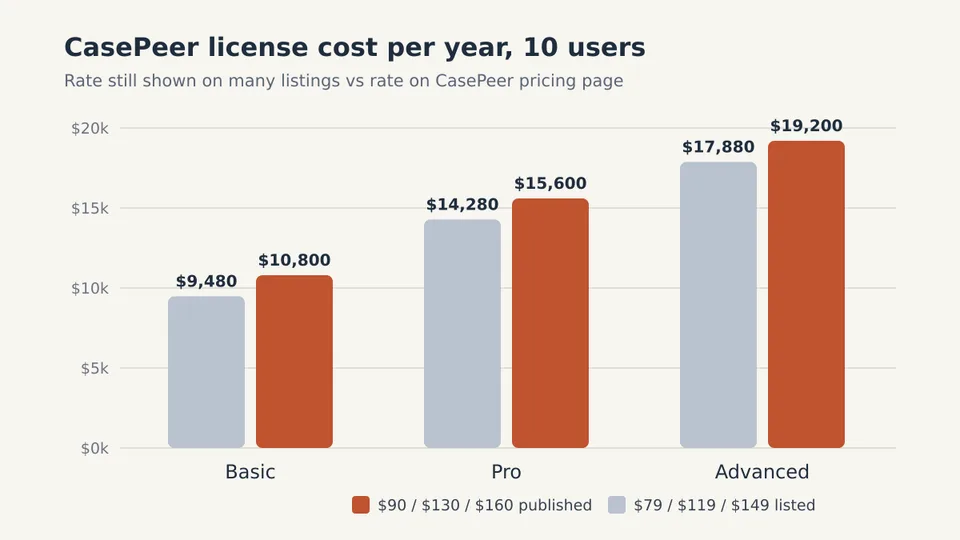
CasePeer costs $90 per user per month on Basic, $130 on Pro and $160 on Advanced, according to its own pricing page. There is no long term contract and no setup fee for most firms, every user at the firm must be on the same tier, and invoices prorate when you add or remove people. For a ten person personal injury firm that is $10,800 to $19,200 a year in licenses.
Many software listings still show $79, $119 and $149, which is an older rate card, so a budget built from them comes out about $1,300 a year short for ten users. Below are the current numbers, what each tier includes, where CasePeer's AI stops, and how it compares with the other case management platforms PI firms get quoted. If you are pricing platforms side by side, our Filevine pricing breakdown and Smokeball pricing per user use the same format.
How much does CasePeer cost?
CasePeer publishes three per user, per month prices: Basic at $90, Pro at $130 and Advanced at $160. Monthly updates, support, training and storage are included. CasePeer says there is no long term contract, plans can be upgraded or downgraded at any time with prorated billing, and there is no setup fee for most firms. E-signature and data migration are sold as add-ons.
| Source | What it says | How current |
|---|---|---|
| CasePeer pricing page | Basic $90, Pro $130, Advanced $160 per user per month. No long term contract or setup fee | Primary, current |
| CasePeer help center | Same three prices. All users must be on the same tier. Next invoice prorates for users added or deactivated | Primary, current |
| Capterra | Starts at $90 per user per month. No free trial, no free version, no card required | Matches the current rate card |
| Several software directories | Basic $79, Pro $119, Advanced $149 | Older rate card, still widely copied |
The same-tier rule matters more than it looks. You cannot put the managing partner on Advanced for API access and keep intake staff on Basic. The tier you need for one person sets the price for everyone.
CasePeer cost per user at four firm sizes
Here is the published rate multiplied out. Count everyone who logs in: attorneys, case managers, paralegals, intake and the person who handles settlements. CasePeer places no limit on the number of attorneys or staff, but each one is a seat.
| Users | Basic ($90) | Pro ($130) | Advanced ($160) |
|---|---|---|---|
| 3 | $270 a month, $3,240 a year | $390 a month, $4,680 a year | $480 a month, $5,760 a year |
| 5 | $450 a month, $5,400 a year | $650 a month, $7,800 a year | $800 a month, $9,600 a year |
| 10 | $900 a month, $10,800 a year | $1,300 a month, $15,600 a year | $1,600 a month, $19,200 a year |
| 20 | $1,800 a month, $21,600 a year | $2,600 a month, $31,200 a year | $3,200 a month, $38,400 a year |
Add-ons are not in these numbers. E-signature is priced separately, and so is any demand letter or medical chronology service you connect through an integration.
What is in CasePeer Basic, Pro and Advanced?
Basic is the case management core: cases and contacts, tasks, a client portal, automated statute alerts, settlement negotiations, medical treatment tracking, case expense tracking, client trust tracking, calendaring and unlimited document storage. Pro, which CasePeer marks as its most popular plan, adds client intake, unlimited two-way texting, case stage screens, litigation event plans, a high value cases report, medical requests and firm productivity reports, 50 more reports, 20 or more integrations and the 8am IQ writing assistant. Advanced adds scheduled texts, data sync for reporting, a multi-office reporting suite, an intake investigator portal, case grades and API access.
For most single office PI firms the real choice is Basic or Pro. Pro is where intake, texting and the integrations live, and integrations are how CasePeer connects to demand letter and records vendors.
Does CasePeer have AI for medical records?
Not built in. CasePeer's AI is 8am IQ, a writing assistant for editing, summaries and translation, included from the Pro tier. Medical chronologies come through third-party integrations: CasePeer lists EvenUp, Novo and Practice AI for demand letters and Arctrieval for medical records. Those vendors price their work separately, often per case.
So a PI firm that wants AI to read records ends up with two bills, the CasePeer seats and the per case vendor. Our EvenUp pricing page lays out what the demand letter vendors charge, and Supio pricing works through the per case model at different caseloads.
Does CasePeer have a free trial or a setup fee?
Capterra lists no free trial and no free version for CasePeer; you book a demo. CasePeer says there is no setup fee for most firms and offers guided implementation, live training and migration from legacy systems, with data migration listed as an add-on. Ask whether your migration is in the no fee group before you sign.
Is CasePeer worth it for a small PI firm?
CasePeer is worth it when you need personal injury case management with a price you can see. It is built around how a plaintiff practice runs (treatment tracking, statute alerts, settlement negotiations, medical requests) and it has no long term contract, so the risk of trying it is a few months of seats. Compared with platforms that quote everything, a published $90 to $160 per seat makes budgeting easy.
Where firms get surprised is everything around the license. Trust accounting still needs a monthly reconciliation against the bank statement, which many firms run in separate bank reconciliation software that matches the statement to your ledger. And reading the medical records, bills and depositions is still a person's job, unless you pay a per case vendor or add a reading tool.
Where a flat priced reading tool fits next to CasePeer
CaseClerk is not case management and does not replace CasePeer. It reads. You upload one matter's medical records, bills, police report, deposition transcripts and insurer letters (up to 1,000 files in 18 formats) and ask questions in plain English: which providers treated the client and when, what the records say about prior injuries, where the gaps in care are, which bills are unpaid. Every answer names the document and page, so the case manager checks the source in seconds.
The price is per account, not per seat: Solo $99 a month for 2,500 pages, Professional $249 for 10,000 pages, Firm $499 for 30,000 pages, annual billing at six months' price, and an Enterprise tier on quote. A five person firm on CasePeer Pro pays $650 a month for case management. Adding CaseClerk Professional for record review costs $249 more, flat, whatever the caseload that month within the page allowance.
CasePeer vs Filevine vs Smokeball on price
| CasePeer | Filevine | Smokeball | |
|---|---|---|---|
| Price published | Yes, $90, $130, $160 per user | No, custom packages | No, four plans quoted |
| Reported or listed per user | $90 to $160 | $49 to $150 reported | $49 to $149 reported |
| Contract | No long term contract | Custom | 12 or 36 months reported |
| Setup | No setup fee for most firms | Reported $5,000 to $25,000 | Onboarding included |
| AI | 8am IQ writing assistant; chronologies via partners | LOIS AI, quoted | Archie AI, add-on |
| Built for | Personal injury | Plaintiff and litigation | Small firms, many practice areas |
CasePeer is the only one of the three you can price without a sales call. That is a real advantage for a small firm, and it is the same reason we publish ours.
What to ask before you sign a CasePeer order
- The tier for everyone. All users sit on one tier, so pick it by the person who needs the most features.
- Seat count by role. Include intake and settlement staff, and ask how inactive users are billed.
- Add-ons in writing. E-signature, text scheduling and data migration, each with a price.
- Integration costs. Which demand letter or records vendor you plan to connect and what it charges per case.
- Rate changes. CasePeer prices have moved before, so ask how much notice you get before the next increase.
Before you pay a per case vendor to read records, run a closed matter through a CaseClerk trial: 25 pages, up to 5 files, no card. It shows in an afternoon whether a reading tool covers the job.