FoundationIP Pricing in 2026 and What Clarivate Charges IP Firms
Clarivate publishes no FoundationIP price, while Software Finder estimates $30,000 to $100,000 a year plus implementation. Compare the estimate, rollout costs and alternatives with published prices before accepting a quote or renewal.
FoundationIP has no published Clarivate price, so your quote or renewal determines what it costs. Software Finder estimates about $30,000 to $100,000 a year plus $10,000 to $40,000 for implementation, based on industry benchmarks. Those are third-party estimates, not a Clarivate quote.
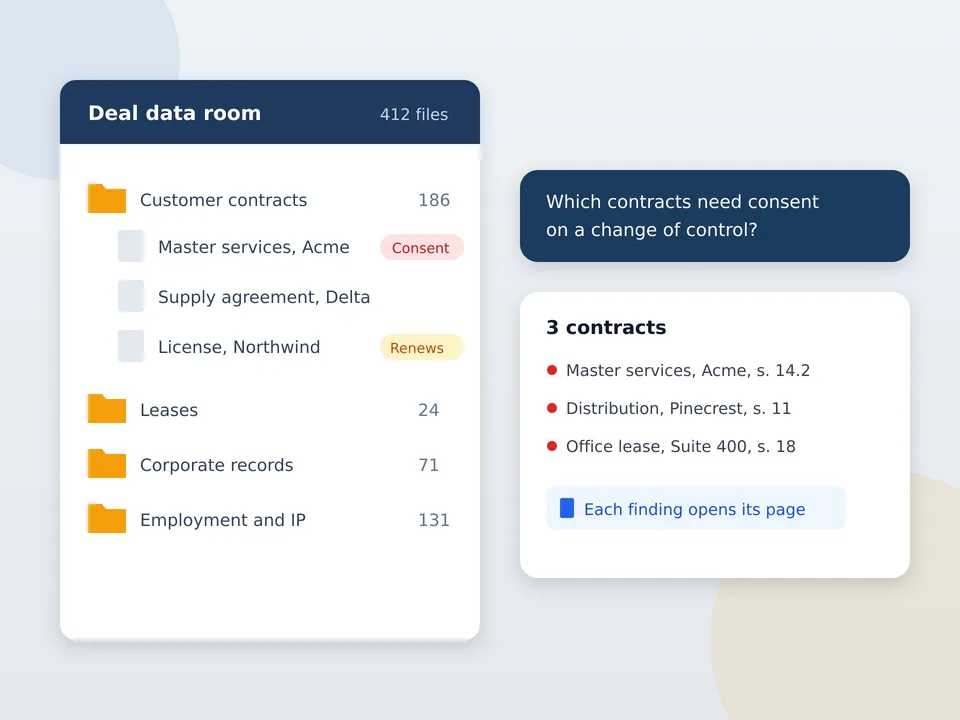
If faster file review is driving the purchase, try CaseClerk with 25 pages and up to 5 files, no card. It answers questions about documents and names the source. It does not handle docketing or compute deadlines.
How much does FoundationIP cost?
Clarivate's FoundationIP page offers a demo or a get started conversation without printing a price. For a US patent or trademark boutique comparing a renewal, distinguish the vendor's terms from directory estimates and reviewers' experiences.
| Source | What it reports | How to use it |
|---|---|---|
| Clarivate FoundationIP page | No published price; request a demo or get started | Get a written quote for your scope. |
| G2 | No pricing supplied by Clarivate; reviewers place perceived cost in the top $$$$$ tier | User perception, not a rate card. |
| Software Finder | Estimated $30,000 to $100,000 annually and $10,000 to $40,000 implementation, according to industry benchmarks | A budgeting estimate, not an offer. |
| Capterra review | A former law firm attorney recommended it only for large law firms or corporate legal departments because of administration needs | An individual review, not a firm-size requirement. |
G2 reports user-reported averages of about 4 months to implement and 29 months to ROI. Neither predicts your rollout or return. G2 also lists 600+ law firm and corporate customers, which does not establish suitability for your practice. Separately, a small-firm reviewer on Software Finder described a rollout of about two years with delays. Treat that as an individual experience rather than a typical timeline.
What a FoundationIP contract includes
Clarivate describes FoundationIP as cloud based IP practice management for law firms of all sizes and calls it the first cloud-based IP management software. Its page lists the following capabilities. Confirm which are included in your proposal and which require additional scope.
- Docketing and reminders. One-click docketing from USPTO Private PAIR, as described on Clarivate's page, docketing from email, task dashboards and email reminders.
- Forms and reporting. Clarivate lists 150+ managed USPTO forms and over 100 system reports.
- Patent relationships. Priority lineage and terminal disclaimer tracking with a family tree view, plus bulk reference import and IDS form generation.
- Law updates. According to Clarivate, automatic law updates and recalculations run 3 times a year across 300+ jurisdictions.
- Access and integrations. Optional direct client access, iManage integration, and links to Innography, PatentScout and the Clarivate IP Collaboration Hub.
Clarivate's FoundationIP page does not describe AI features. If the sales conversation includes faster document reading, ask for a demonstration of that exact workflow and the product responsible for it before assigning it value in your comparison.
What drives a FoundationIP quote
Software Finder says the estimate varies with users, jurisdictions, data modules and support. Ask Clarivate to itemize those assumptions rather than comparing headline totals from proposals with different scope.
For users, ask which roles require paid access. For jurisdictions and modules, identify what your practice actually uses. For support, ask what assistance is included and what would be separately charged. These are contract questions, not claims about a published FoundationIP billing formula.
Separate implementation and migration from recurring charges. Ask who maps matter records, checks imported deadlines and resolves discrepancies. Request a written acceptance process, training scope and ownership of the work. On renewal, ask for the price of the existing configuration separately from proposed additions so that the reason for any increase is visible.
FoundationIP cost over three years for a small IP firm
The illustration below uses Software Finder's annual estimate endpoints and a $25,000 implementation assumption, the arithmetic midpoint of its $10,000 to $40,000 estimate. It is not a Clarivate quote or a prediction of a small firm's bill. Recurring prices stay constant and implementation is paid once.
| Illustrative cost | Lower estimate scenario | Higher estimate scenario |
|---|---|---|
| Annual subscription, Software Finder estimate | $30,000 | $100,000 |
| Implementation midpoint assumption | $25,000 | $25,000 |
| First year, calculated | $55,000 | $125,000 |
| Second and third year, each | $30,000 | $100,000 |
| Three-year total, calculated | $115,000 | $325,000 |
The totals are annual subscription multiplied by three, plus implementation. They exclude internal staff time and any separately quoted migration or services outside that assumption. Replace these inputs with your proposal before approving a budget, and ask whether implementation already includes migration to avoid counting it twice.
FoundationIP alternatives with published prices
Alt Legal publishes prices directly. The DocketTrak and AppColl figures below come from G2 listings. Anaqua and Patrix have no published price, so they remain quote comparisons. A lower starting price does not establish equivalent jurisdiction coverage, migration scope or workflows.
| Product and source | Published or listed price | Billing basis |
|---|---|---|
| Alt Legal, vendor pricing page | Up to 50 matters $60/month; 100 $100; 200 $195; 400 $295; 1,000+ custom | Docketed matters, unlimited users |
| DocketTrak, G2 | Standard Edition $75/month for up to five attorney or paralegal users | Listed edition with that user allowance |
| AppColl, G2 | PM Pro from $100/month | Users and matters, per G2 |
| Anaqua PATTSY WAVE | No published price | Request billing terms in a quote |
| Patrix Patricia | No published price | Request billing terms in a quote |
Alt Legal's pricing page lists Trademark Protection add-ons of $30, $40, $60 and $95 a month for the respective 50, 100, 200 and 400 matter tiers. It states no setup fee, free data migration usually within a week, and included support and training. It offers a demo rather than a trial. Confirm migration scope for your records instead of assuming every transfer fits that timetable.
Compare vendors using the same matter mix and required tasks. A trademark-focused practice and a patent prosecution group may value different functions. For the separate document reading budget, our legal AI pricing comparison helps compare published prices.
Is FoundationIP worth it for a small IP firm?
It can be worth evaluating when the firm needs the docketing, jurisdiction coverage, patent relationship tracking and integrations Clarivate describes, and can assign responsibility for administration. Ask the demonstration to follow your actual patent and trademark workflows rather than accepting a general feature tour.
The Capterra review raises a practical question about who will maintain the system. Ask your docketing lead to review the implementation scope and ongoing duties. A boutique should compare the contract against a simpler docketing option using the same requirements. If the main frustration is reading prosecution files or agreements, test that job separately before funding a broader platform change.
Where CaseClerk fits and what it does not do
CaseClerk is not docketing software and does not compute deadlines. Docketing stays in your docketing system. CaseClerk lets you upload a matter's documents and ask plain-English questions. Every answer names the source document.
Upload office actions, prosecution history, license agreements, assignment documents, opposition filings and prior art PDFs. Before a response, ask what the file wrapper says about a disputed limitation. For license review, ask which agreements restrict field of use or require consent to sublicensing, then check the named documents. Our contract review software for law firms page covers that reading task.
In portfolio diligence, use questions to identify relevant agreements and assignments. When checking chain of title on acquired patents, use a USPTO patent assignment search to investigate recorded transfers alongside the documents you review. Our AI due diligence software page explains the portfolio document review workflow.
| CaseClerk plan | Monthly price | Pages read |
|---|---|---|
| Solo | $99 | 2,500 |
| Professional | $249 | 10,000 |
| Firm | $499 | 30,000 |
| Enterprise | $998 | 60,000 |
CaseClerk bills per account by pages read, not per user. Annual billing costs six months' price. It supports 20 file formats and up to 1,000 files per case. If faster file review is driving the FoundationIP quote, this budget item is far cheaper to test separately. It does not replace deadline management.
FoundationIP pricing questions
Is FoundationIP part of Clarivate?
Yes. FoundationIP is Clarivate's cloud IP practice management and docketing software for law firms. Clarivate describes it as serving firms of all sizes and lists docketing, forms, reporting, patent relationship tracking and integrations. That positioning does not tell you what a particular contract will cost.
Does FoundationIP have a free trial?
Clarivate's FoundationIP page offers a demo and a get started route rather than published trial terms. Ask whether a trial is available, what it covers and whether your own matters can be used. Do not treat a product demonstration as confirmation of a free trial.
What is cheaper than FoundationIP?
Alt Legal publishes plans from $60 a month. G2 lists DocketTrak Standard at $75 a month and AppColl PM Pro from $100 a month. Those starting figures are below Software Finder's FoundationIP estimate, but scope differs. CaseClerk starts at $99 a month for document questions, without docketing.
How long does FoundationIP take to implement?
G2 reports a user-reported average of about 4 months. An individual small-firm reviewer on Software Finder described about two years with delays. Neither is a commitment for your firm. Ask Clarivate for a migration plan with responsibilities, validation steps and acceptance criteria tied to your records.
Keep your docketing requirements in the contract comparison and test file review on a matter you know. Start the CaseClerk trial with 25 pages and up to 5 files, no card, and check the source document behind each answer.